
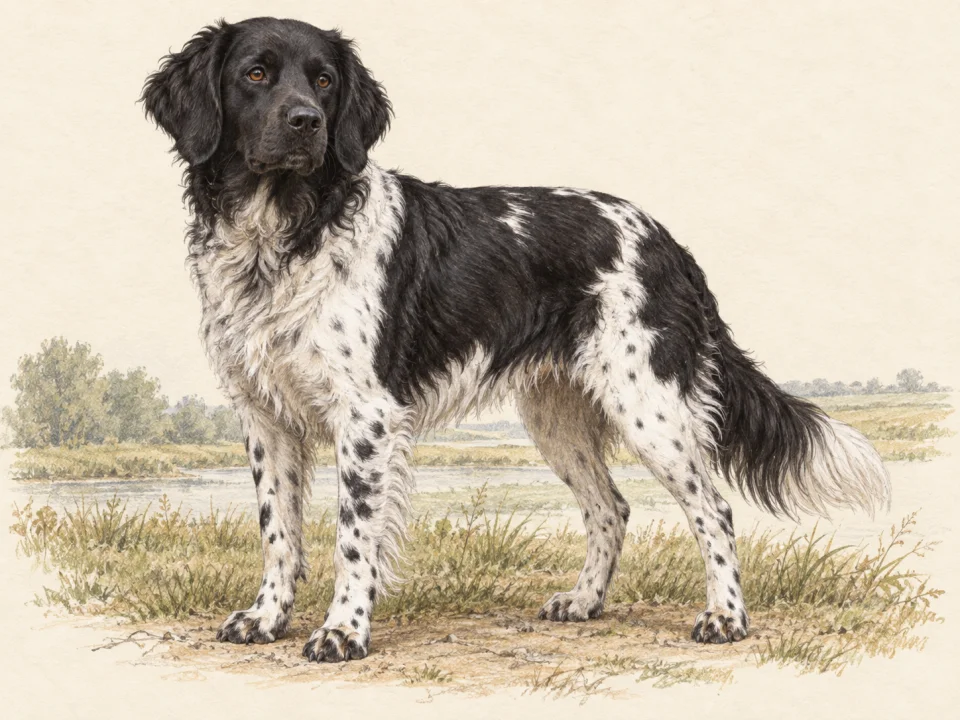
Give the independent worker a task you can supervise
The Ameri-Can association describes curiosity and independent working as part of the Staby’s character. In a home garden, that makes it useful to decide which areas are available to the dog and which beds or boundaries need protection. Supervise exploration instead of waiting to discover a new digging project. Offer an appropriate search game or a brief training task, and practice returning to you in an easy setting before adding distractions. The association advises positive reinforcement and avoiding endless repetitions. If a lesson deteriorates, simplify it and finish with an achievable step rather than escalating pressure. An alert bark can be a prompt to assess the situation and redirect the dog; do not assume repeated barking will resolve simply because the breed is described as gentle.[1]
Separate the questions a health record can answer
The UK association discusses hip and elbow dysplasia, epilepsy, patent ductus arteriosus and other conditions, and explicitly cautions that testing cannot guarantee lifelong health. Ask what the parents were assessed for and how, rather than accepting a single all-clear label. Joint imaging, a clinical heart assessment, family health history and DNA results answer different questions. Keep them in separate entries when comparing a litter’s records. The UK page describes its own breeding policies; do not assume a UK scoring threshold is automatically the rule in every country. A puppy still needs its own veterinary examination, even where both parents have documented screening. Share any diagnosed problem with the breeder and relevant breed health program using the actual veterinary findings.[2]
Know the name of the DNA test
Utrecht University lists a cerebral dysfunction DNA test specifically for the Friesian Stabyhoun. If this appears in a breeder’s information pack as CD or a similar abbreviation, ask for the full condition name and the laboratory interpretation. It is a test addressing a particular inherited disorder, not a general certificate of normal brain function and not a heart test. Match the report to the named dog and discuss what the parents’ results mean for the proposed mating with the breeder and veterinarian. An unusual movement or developmental concern in your own puppy needs clinical assessment; a breed page or a reassuring genetic result should not be used to diagnose or dismiss it.[3]
Frequently asked questions
Does the Stabyhoun’s gentle reputation mean it will ignore wildlife?
No. It retains an independent working nature. Supervise outdoor exploration and practice recall with controlled distractions rather than assuming a friendly family dog will not investigate or pursue.
Source [1]Do health-tested parents guarantee a healthy Stabyhoun puppy?
No. The UK breed association states that screening and background checks cannot provide that guarantee. Review the specific tests and arrange the puppy’s own veterinary examination.
Source [2]Is the cerebral dysfunction DNA test also a heart clearance?
No. Utrecht lists it for a specific inherited condition. Request separate documentation for any heart assessment and ask the veterinarian to explain the scope of each result.
Source [3]FAQ sources
- Ameri-Can Stabyhoun Association — About the breed ↗FAQ reference 1
- UK Stabyhoun Association — Breed health ↗FAQ reference 2
- Utrecht University — Veterinary genetics DNA tests ↗FAQ reference 3
Sources & methodology
Breed-level measurements and comparison scores provide context. They do not predict an individual dog's health, behaviour or suitability. Open the original publisher pages below to verify the facts and compare any later updates.
- Ameri-Can Stabyhoun Association — About the breed ↗Reference 1 · reviewed 2026-09-27
- UK Stabyhoun Association — Breed health ↗Reference 2 · reviewed 2026-09-27
- Utrecht University — Veterinary genetics DNA tests ↗Reference 3 · reviewed 2026-09-27
Make it about your dog
Build a profile around your dog's age, experiences and everyday needs.
Meet your dog →Explore local care