
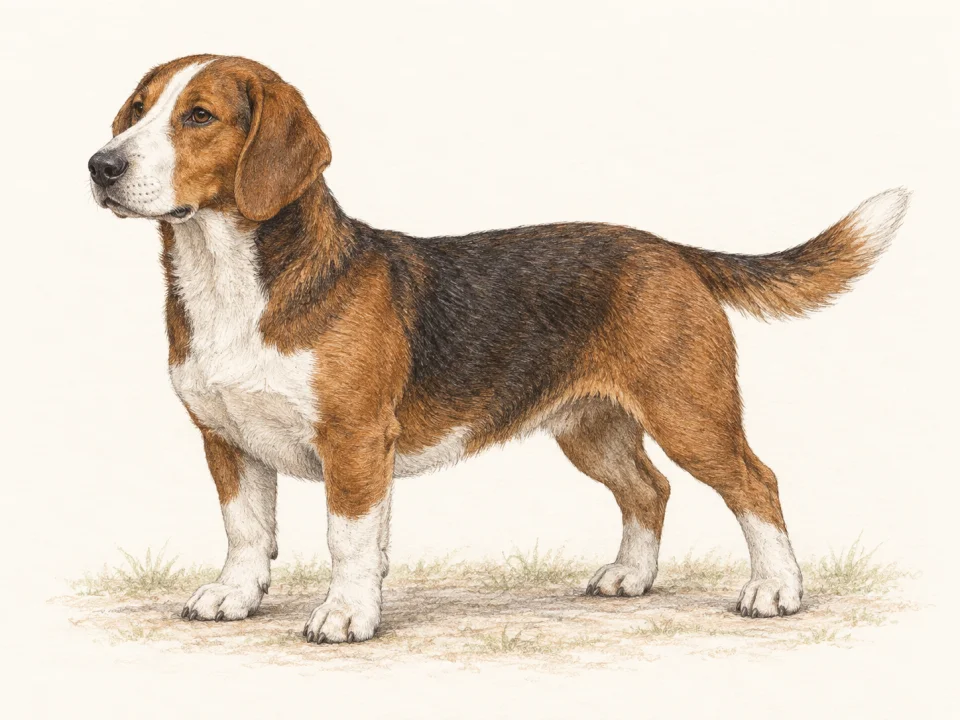
Why the hunting background belongs in a companion-dog decision
The FCI standard describes the Drever as a Swedish hunting dog used for deer, hare and fox, with companion-only ownership unusual in that context. AKC also describes affectionate behavior and time relaxing with people. These accounts address different settings; being affectionate does not establish that a dog will be comfortable with a particular household routine. When meeting an adult Drever, ask how its time has actually been divided between hunting, home life and kennels. Ask what happens on days without field work, and whether it has lived with your kind of daily absence or shared entrance. For a puppy, ask about the parents’ lives and the breeder’s experience placing dogs in comparable homes. Treat answers about the individual and its upbringing as more useful than a blanket “good family dog” label.[2]
A nose-led walk is a different task from a quiet neighborhood stroll
AKC highlights scent-following and the need to teach responses to cues. For a prospective owner, the useful demonstration is an ordinary walk: can the handler regain the dog’s attention after an interesting smell, and what equipment and practice make that possible? A response in the breeder’s kitchen does not answer that question. As a practical planning exercise, identify a secure place for exploration and a route where you can keep physical control near roads and wildlife. Discuss suitable scent activities with an instructor rather than assuming that more distance is the only way to provide interest. Introduce any new activity to suit the individual dog’s age and health. Short legs are not evidence of low exercise needs, and a hunting background is not a prescription for a fixed daily mileage.[1]
Ask about the sound of everyday life, not just friendliness
AKC notes vocal behavior during alerting and play. Before committing to a home with shared walls, ask specifically about visitors arriving, dogs passing and excited play; a quiet meeting is only one observation. If adopting an adult, request examples from its existing carers rather than a promise that it will be silent after training. Include everyone who would handle the dog in that conversation so expectations match. Its coat presents a separate, relatively straightforward task: AKC describes short coarse hair, some shedding and occasional bathing. That does not make vocal behavior or scent-led outings equally simple. Judge the whole routine, including the parts that cannot be solved by choosing a smaller bed or an easy-care coat.[1]
Frequently asked questions
Is the Drever primarily a companion breed in Sweden?
The FCI standard emphasizes its hunting role and says companion-only ownership is unusual in that setting. This does not decide an individual placement, but it is a reason to investigate working background and daily needs carefully.
Source [1]Does the Drever’s short coat mean it does not shed?
No. AKC describes some shedding despite the relatively easy-care short coat. Coat maintenance and shedding are separate considerations.
Source [2]Can I assume a Drever will ignore wildlife on walks?
No. AKC emphasizes its tendency to follow scent. Assess the individual, practice responses to cues and maintain physical control where following a scent could lead into danger.
Source [2]FAQ sources
- FCI Standard No. 130 — Drever, 2021 ↗FAQ reference 1
- American Kennel Club — Drever ↗FAQ reference 2
Sources & methodology
Breed-level measurements and comparison scores provide context. They do not predict an individual dog's health, behaviour or suitability. Open the original publisher pages below to verify the facts and compare any later updates.
- American Kennel Club — Drever ↗Reference 1 · reviewed 2026-09-27
- FCI Standard No. 130 — Drever, 2021 ↗Reference 2 · reviewed 2026-09-27
Make it about your dog
Build a profile around your dog's age, experiences and everyday needs.
Meet your dog →Explore local care