
Understand hunt, point and retrieve before planning activities
The UK breed club’s training program includes scenting, pointing, steadiness, retrieving and water work. These are separate skills, not simply different ways to run farther. For a companion home, an introductory session with an experienced, reward-based gundog trainer can help turn interest in finding and carrying into controlled activities. Ask for beginner exercises appropriate to the dog rather than copying a finished field dog’s routine. Plan where you can practice safely and what you will do on days when a long outing is impractical. Water ability also needs assessment: the club caters for non-swimmers as well as experienced dogs. A breed description that mentions water work does not justify sending an inexperienced dog into deep or moving water.[2]
The rough coat has a seasonal underlayer
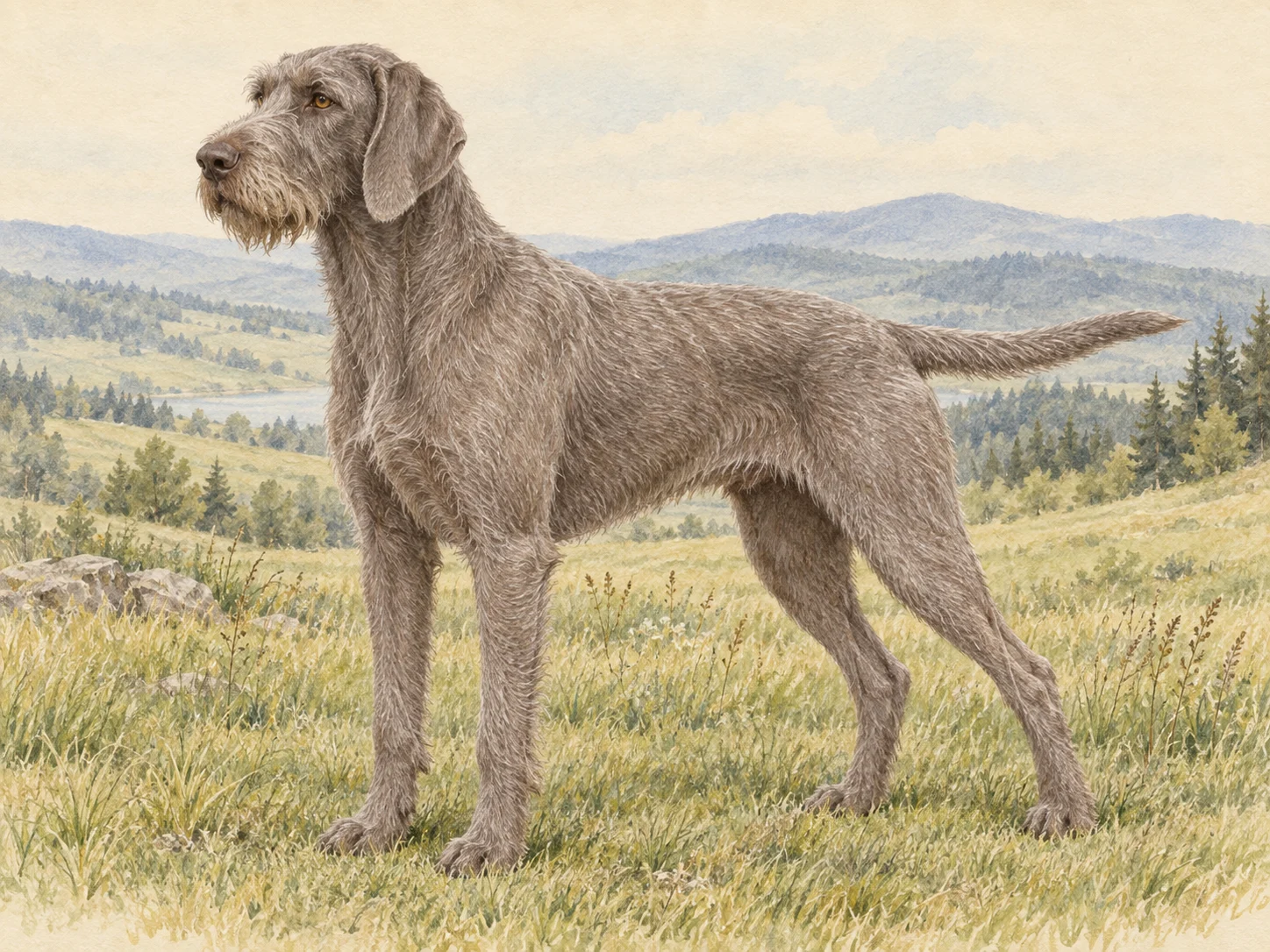
FCI describes a harsh, straight outer coat of about 4 cm, a short fine undercoat normally lost in summer, and softer hair forming the moustache. A wirehaired appearance therefore does not mean no shedding. After outdoor work, inspect the face, feet and coat for caught material before settling indoors. Keep grooming gentle and ask for practical advice if the coat is difficult to maintain. Coat type is not a diagnosis: new bald patches, itching or sore skin should not simply be explained as seasonal shedding. For size comparisons, use the source as well as the number: the FCI shoulder-height ranges are 62–68 cm for males and 57–64 cm for females. They differ from the AKC overview shown above, particularly the female upper limit. FCI does not specify a numeric weight range; the 50–65-pound figure comes from AKC. Measure the individual before choosing a travel crate or harness instead of treating either overview as a sizing chart.[1]
Read survey information without turning it into a health guarantee
The UK club collects voluntary general-health, skin and longevity surveys. Its page notes limited reporting and includes older hip-score statistics, so those figures should not be treated as the present-day risk for every puppy. A small number of reports does not establish a low disease rate without knowing who participated and which dogs were assessed. The club recommends hip scoring and notes reported idiopathic epilepsy cases; an owner survey cannot diagnose either condition in your dog. Ask the breeder about formal screening and relevant family history, and use veterinary care for symptoms. If you contribute to a survey, use the diagnosis and dates from the veterinary record rather than assigning a cause from a photograph or an internet description.[3]
Frequently asked questions
Can I assume my Slovakian Pointer already knows how to swim?
No. The breed club offers water training at different experience levels, including non-swimmers. Start with suitable instruction and safe conditions rather than assuming breed heritage makes a dog water-ready.
Source [1]Does the wire coat mean this breed does not shed?
No. FCI describes a fine undercoat normally lost in summer beneath the harsh outer hair. Distinguish ordinary seasonal change from itching, soreness or new bald patches.
Source [2]Do a few reported health cases prove the breed is almost disease-free?
No. Voluntary reports do not provide a reliable disease rate without adequate participation and context. Use actual screening records and veterinary advice, not the number of survey responses, to assess a dog.
Source [3]Why does the female height range differ between AKC and FCI descriptions?
The sources publish different ranges. Our quick facts reproduce AKC’s 22.5–26 inches for females; FCI specifies 57–64 cm, about 22.4–25.2 inches. These are source-specific breed descriptions, not exact conversions of the same range. Use the individual dog’s measurements for equipment and the applicable organization’s standard for showing.
Source [2]FAQ sources
- Slovakian Rough Haired Pointer Club UK — Gundog Work ↗FAQ reference 1
- FCI — Wirehaired Slovakian Pointer standard No. 320 ↗FAQ reference 2
- Slovakian Rough Haired Pointer Club UK — Breed Health ↗FAQ reference 3
Sources & methodology
Breed-level measurements and comparison scores provide context. They do not predict an individual dog's health, behaviour or suitability. Open the original publisher pages below to verify the facts and compare any later updates.
- FCI — Wirehaired Slovakian Pointer standard No. 320 ↗Reference 1 · reviewed 2026-09-27
- Slovakian Rough Haired Pointer Club UK — Gundog Work ↗Reference 2 · reviewed 2026-09-27
- Slovakian Rough Haired Pointer Club UK — Breed Health ↗Reference 3 · reviewed 2026-09-27
- American Kennel Club — Slovakian Wirehaired Pointer overview ↗Reference 4 · reviewed 2026-09-27
Make it about your dog
Build a profile around your dog's age, experiences and everyday needs.
Meet your dog →Explore local care