
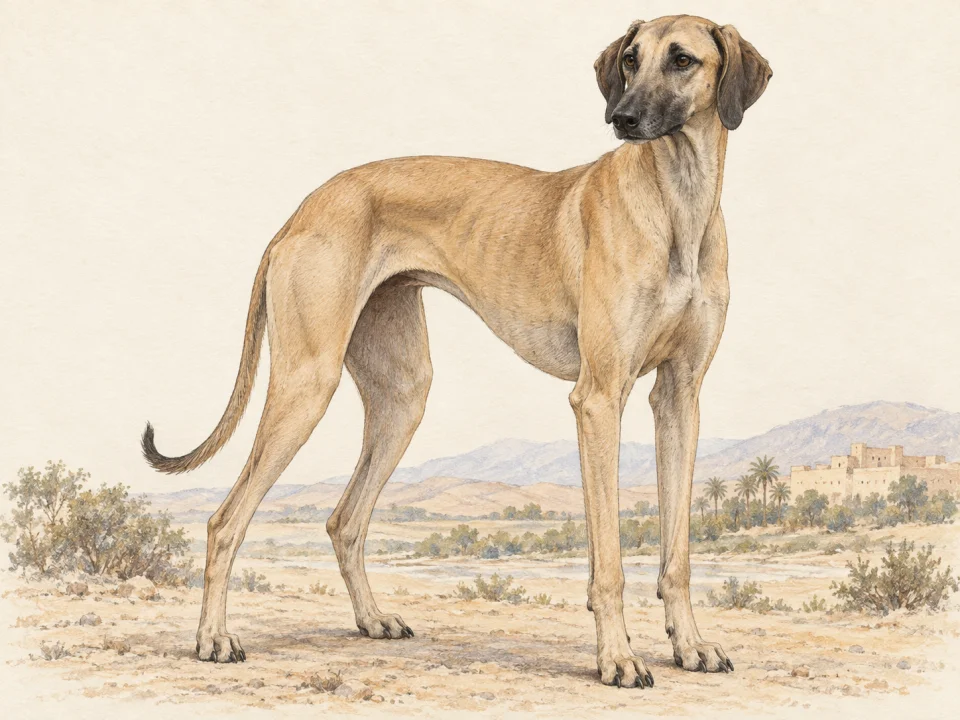
Plan the running space before choosing the dog
The American Sloughi Association emphasizes secure exercise and warns against free running in an unenclosed area. Before arranging a first run, walk the perimeter, check gates and decide who controls the entrance. An unfamiliar shared enclosure adds other dogs and opening gates to that assessment; a fence alone does not make every session suitable. Match the activity to the dog’s age, condition and veterinary advice. Social introductions need their own plan: the club distinguishes natural reserve from fear. Give visitors a simple instruction to allow space and let the dog choose whether to approach. Persistent fear needs attention rather than being dismissed as normal aloofness. A relaxed relationship with family also does not prove safety around unfamiliar small animals.[1]
Lean is a body type, not a diagnosis
AKC’s explanation of sighthound build highlights the Sloughi’s naturally visible skeletal outline while also warning that a sighthound can be too thin. Neither “I can see a rib” nor “this breed is always skinny” settles an individual dog’s condition. At a routine visit, ask your veterinarian to assess both body fat and muscle, and establish a useful weight baseline. If appearance changes, take comparable side and overhead photographs and note appetite, activity and the measured weight for the appointment. This is an observation record, not a home diagnosis. Do not feed to match the silhouette of a heavier-built breed, but do not explain away unexplained weight loss with the breed’s lean appearance either.[2]
Eye screening has two separate parts
The association’s August 2017 veterinary health statement recommends an OFA eye examination within the 12 months before breeding as well as DNA screening for progressive retinal atrophy. These are separate records: a genetic result and a dated examination are not interchangeable. Its current health page also calls for disclosure of PRA DNA results. Ask for the actual documents and confirm current breeding recommendations with the association, rather than treating the older statement as a complete present-day checklist. If your own dog develops a change in vision, an earlier normal result is not a reason to defer veterinary assessment. A test addressing PRA should not be presented as clearance from every possible eye problem.[3]
Frequently asked questions
Does being quiet indoors make a Sloughi a low-exercise dog?
No. The parent club describes a need for regular activity and safe running opportunities. Plan access to a secure area and match exercise to the individual; do not use an unenclosed field to test recall.
Source [1]Should I increase food until my Sloughi looks like a stockier breed?
No. Sloughis have a naturally lean sighthound build. Ask your veterinarian to assess body condition and muscle rather than using another breed’s silhouette as the target. Unexplained weight loss still needs attention.
Source [2]Does a PRA DNA result replace the eye examination?
No. The association’s 2017 statement lists DNA testing and a recent OFA eye examination separately. Obtain both records where applicable and confirm the latest recommendations with the club.
Source [3]FAQ sources
- American Sloughi Association — Temperament and exercise ↗FAQ reference 1
- AKC — The Skinny on Sighthounds ↗FAQ reference 2
- American Sloughi Association — August 2017 health statement ↗FAQ reference 3
Sources & methodology
Breed-level measurements and comparison scores provide context. They do not predict an individual dog's health, behaviour or suitability. Open the original publisher pages below to verify the facts and compare any later updates.
- American Sloughi Association — Temperament and exercise ↗Reference 1 · reviewed 2026-09-27
- AKC — The Skinny on Sighthounds ↗Reference 2 · reviewed 2026-09-27
- American Sloughi Association — August 2017 health statement ↗Reference 3 · reviewed 2026-09-27
- American Sloughi Association — Health ↗Reference 4 · reviewed 2026-09-27
Make it about your dog
Build a profile around your dog's age, experiences and everyday needs.
Meet your dog →Explore local care