
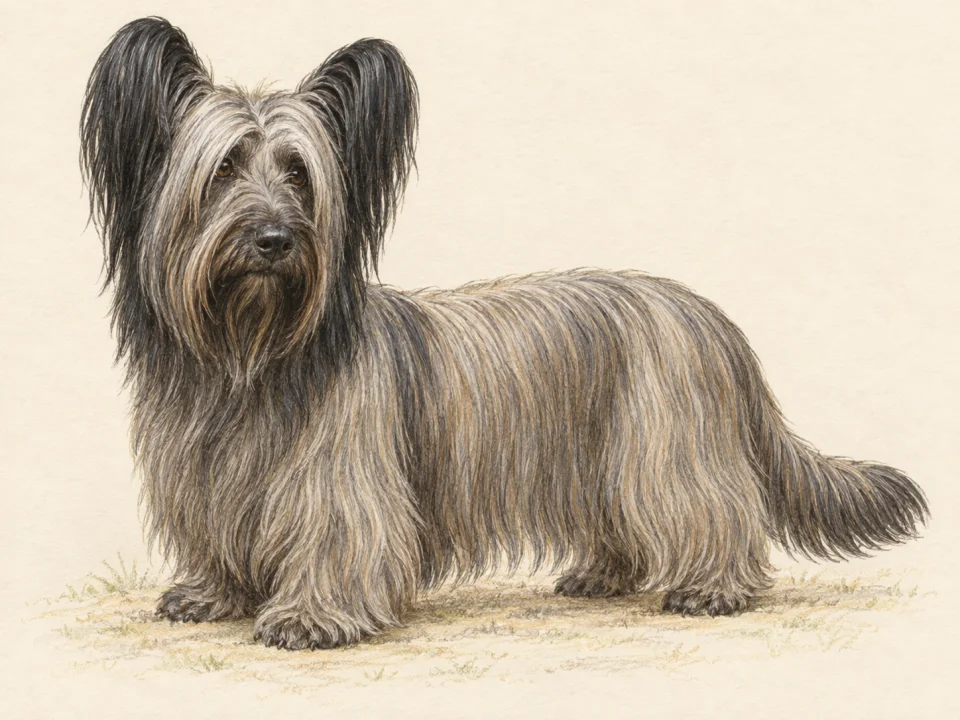
Look beneath the long silhouette
The breed standard describes substantial bone and a body about twice its shoulder height in length. This is useful context when choosing transport: do not buy a carrier solely because the dog stands low to the ground. Measure the individual and check that it can stand, turn and lie comfortably, and that you can manage the occupied carrier. Both upright and dropped ears are accepted in the standard; a drop-eared Skye is not automatically a crossbreed. The standard also describes reserve with strangers. Let a visitor wait for the dog to approach rather than leaning over it or reaching through its face hair. Treat the individual’s behavior as information, not as an obligation to perform a greeting.[1]
A practical brief for the grooming appointment
The American parent club emphasizes that a pet’s long coat still needs maintenance. Its bathing advice is to work shampoo through gently rather than scrubbing the hair into tangles, and it identifies long-pin brushes and long-toothed combs as useful tools. Weekly grooming is its starting point, not a promise that every coat stays comfortable for seven days. Before the appointment, tell the groomer whether you want to preserve the natural coat and point out any areas your dog resists having touched. Ask which tasks you can safely maintain at home. If a mat is tight or handling hurts, let a professional assess it rather than forcing a comb through or cutting close to hidden skin. After an outing, checking the coat for caught debris is a separate task from completing a full grooming session. A clean-looking outer layer is not proof that the coat underneath is tangle-free.[2]
Frequently asked questions
Can a purebred Skye Terrier have ears that fold down?
Yes. The AKC standard accepts both upright and dropped ears. Ear carriage alone does not establish that a dog is mixed-breed.
Source [1]Does a pet Skye need grooming even if it never enters a show?
Yes. The parent club explicitly includes pets in its coat-care advice. Decide on a manageable grooming routine before choosing the breed; skipping shows does not remove the risk of tangles.
Source [2]Should I scrub a Skye’s long coat vigorously during a bath?
The club advises working shampoo through the coat gently instead of scrubbing. If the coat is already tightly matted, seek grooming help rather than treating a bath as a way to remove the mats.
Source [2]FAQ sources
- AKC — Official Skye Terrier standard ↗FAQ reference 1
- Skye Terrier Club of America — Care and Grooming ↗FAQ reference 2
Sources & methodology
Breed-level measurements and comparison scores provide context. They do not predict an individual dog's health, behaviour or suitability. Open the original publisher pages below to verify the facts and compare any later updates.
- AKC — Official Skye Terrier standard ↗Reference 1 · reviewed 2026-09-27
- Skye Terrier Club of America — Care and Grooming ↗Reference 2 · reviewed 2026-09-27
Make it about your dog
Build a profile around your dog's age, experiences and everyday needs.
Meet your dog →Explore local care