
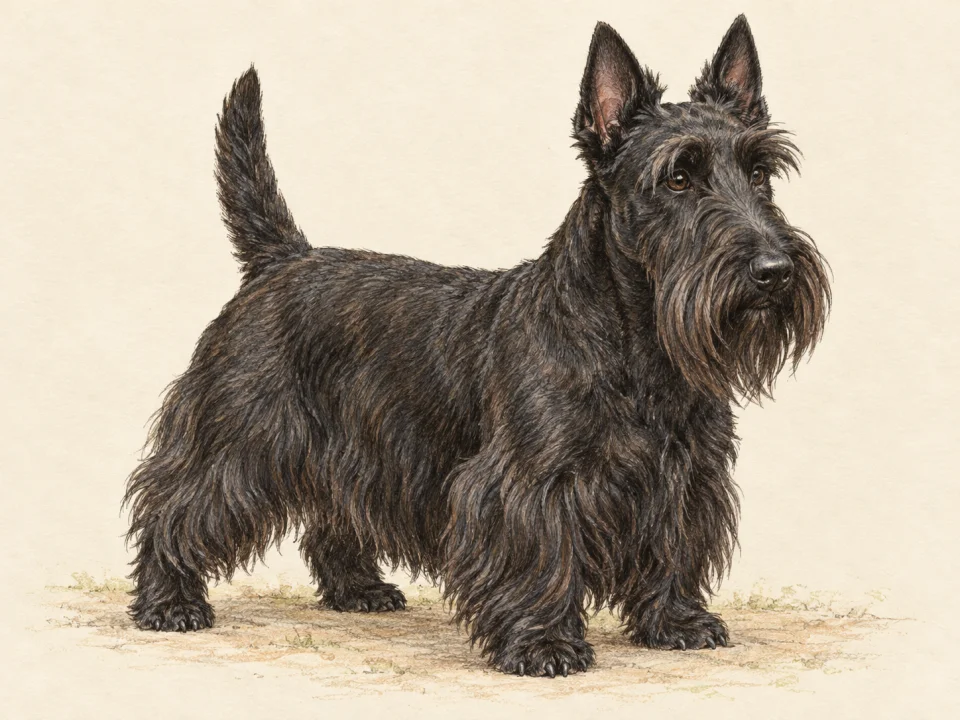
Choose a coat-care method you can maintain
AKC describes hand stripping as the traditional way to maintain the Scottie’s harsh outer coat, while accepting clipping as an option for pets and noting that it changes texture. Discuss both with a groomer who understands the breed before choosing an appointment schedule. Ask what work you must do between visits, how the beard and lower-body furnishings will be kept free of tangles, and how the dog will be introduced to handling comfortably. A clipped coat still requires attention; a hand-stripped coat requires access to someone with the relevant skill. Neither choice is an excuse to work through pain or skin irritation. Take the dog’s tolerance and practical care needs into account rather than asking only whether the finished outline resembles a show photograph.[1]
Three named tests plus an elective is not every test
The club statement effective January 2025 requires Scottish Terrier type III von Willebrand disease DNA testing, patella evaluation and CMO DNA testing for CHIC, plus one elective from its listed options. The elective may be thyroid, eye, Legg-Calve-Perthes, bile acid or kidney screening. Therefore two dogs with completed requirements may not have had the same elective assessment. Ask which one was selected and request the actual report alongside the three named tests. Check the dog’s identity and dates, and discuss unfamiliar findings with your veterinarian. Confirm the latest requirements with the club or OFA before using the list for a breeding decision. A broad label such as fully tested cannot tell you which conditions were assessed or what the results were.[2]
Include smoke exposure in the household plan
Purdue reported an association between cigarette-smoke exposure and bladder cancer in a study following Scottish Terriers. The researchers also described exposure through smoke carried on clothing, including in homes where the owners did not smoke. The useful household response is to reduce exposure, not to predict whether a particular dog will develop cancer. Consider the car, visiting smokers and places where the dog spends time with caregivers as well as the main living room. Ask people caring for the dog to keep smoke away from it and discuss the breed’s bladder-health concerns with your veterinarian. A smoke-free environment does not eliminate all cancer risk: Purdue explicitly notes that some unexposed dogs developed cancer and some exposed dogs did not. This is one modifiable part of care, not a prevention guarantee.[3]
Frequently asked questions
Can a pet Scottie be clipped instead of hand stripped?
Yes. AKC describes clipping as an acceptable pet option while noting that coat texture changes. Discuss comfort, maintenance between appointments and your groomer’s experience before choosing.
Source [1]Does completing the club’s CHIC list mean every elective test was done?
No. The statement effective January 2025 lists three mandatory tests and one elective choice. Request the reports to see which elective was actually performed.
Source [2]Does keeping smoke away guarantee my Scottie will avoid bladder cancer?
No. Purdue’s study supports reducing exposure, but individual outcomes varied. Keep veterinary care and discussion of the breed’s risks separate from any claim of guaranteed prevention.
Source [3]FAQ sources
Sources & methodology
Breed-level measurements and comparison scores provide context. They do not predict an individual dog's health, behaviour or suitability. Open the original publisher pages below to verify the facts and compare any later updates.
- American Kennel Club — Scottish Terrier care ↗Reference 1 · reviewed 2026-09-27
- Scottish Terrier Club of America — CHIC health statement effective January 2025 ↗Reference 2 · reviewed 2026-09-27
- Purdue University — Scottish Terrier smoke-exposure research, January 2024 ↗Reference 3 · reviewed 2026-09-27
Make it about your dog
Build a profile around your dog's age, experiences and everyday needs.
Meet your dog →Explore local care