
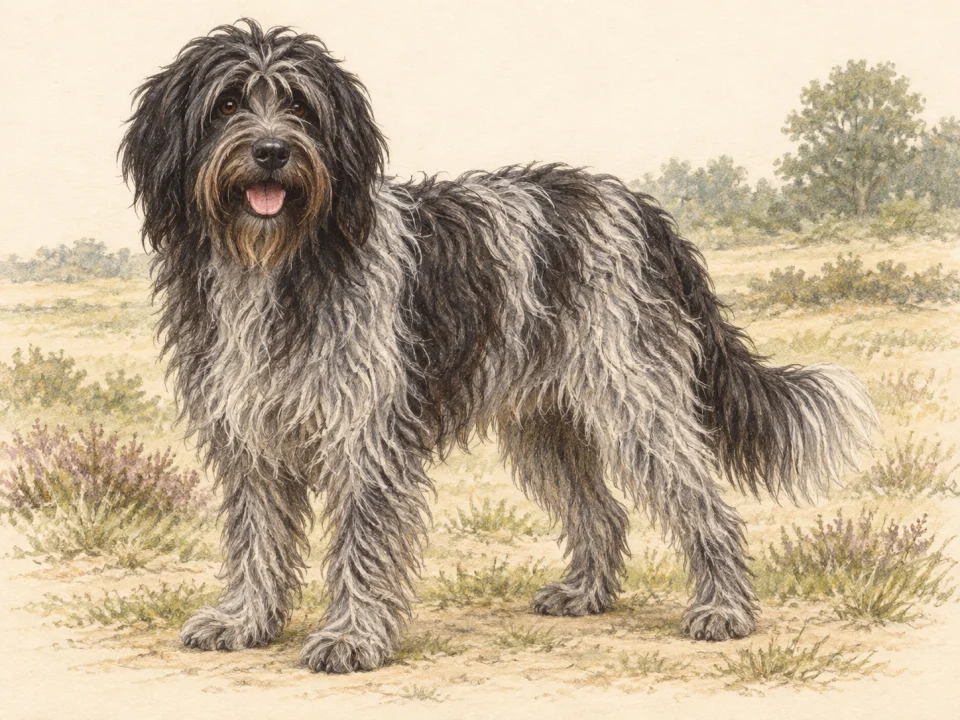
The puppy-to-adult coat deserves its own plan
The Canadian breed club describes a period of increased tangling as the puppy coat gives way to the adult coat, often beginning around 8–12 months, with individual and seasonal variation. A grooming schedule that worked for the young puppy may not be enough during that transition. Ask for a demonstration of combing in layers so you can reach tangles beneath the tousled surface. Check friction areas around the collar, behind the ears and under the legs rather than assuming the visible outer hair tells the whole story. Build comfortable handling before the coat becomes demanding. If a session starts to hurt or the dog struggles, stop and seek a groomer’s help rather than pulling harder or restraining it through a long session. Keep a note of where tangles recur so the next grooming appointment can address the problem. A naturally shaggy appearance and an uncomfortable matted coat are different things.[2]
A rare breed still needs specific eye-health evidence
The Finnish breed association identifies a CCDC66 mutation associated with generalized progressive retinal atrophy in Schapendoes. Rarity is therefore not evidence that inherited eye disease is absent. Ask which mutation a DNA report covers, which dog was sampled and what the result says. If a breeder describes a puppy as clear through its parents, request the supporting records instead of treating a verbal assurance as a laboratory result. Also ask about clinical eye examinations: the Danish club’s breeding guidance includes both DNA information and eye examination, although its registration rules are specific to Denmark. This provides a useful distinction for buyers elsewhere, not a claim that Danish rules apply in the United States. Have your veterinarian interpret unfamiliar records and discuss any visual changes. A result for one mutation cannot establish that every possible cause of eye disease has been excluded.[3]
Frequently asked questions
Why is my adolescent Schapendoes suddenly getting more tangles?
The Canadian club describes extra matting during the transition from puppy to adult coat. Review the combing technique and frequency with a groomer rather than assuming the earlier routine still works. Skin discomfort or a sudden abnormal coat change also warrants veterinary advice.
Source [1]Are Schapendoes free of hereditary eye disease because they are uncommon?
No. The Finnish breed association describes a known CCDC66 mutation associated with gPRA in the breed. Request specific test records rather than relying on rarity as a health claim.
Source [2]Is a gPRA DNA result the same as an eye examination?
No. They provide different information; the Danish club’s guidance lists genetic status and clinical eye examination separately. Ask your veterinarian which records and follow-up are appropriate for the individual dog.
Source [3]FAQ sources
- Schapendoes Club of Canada — Health and coat care ↗FAQ reference 1
- Finnish Schapendoes breed association — gPRA ↗FAQ reference 2
- Danish Schapendoes Club — Breeding guidance ↗FAQ reference 3
Sources & methodology
Breed-level measurements and comparison scores provide context. They do not predict an individual dog's health, behaviour or suitability. Open the original publisher pages below to verify the facts and compare any later updates.
- FCI — Nederlandse Schapendoes standard ↗Reference 1 · reviewed 2026-09-27
- Schapendoes Club of Canada — Health and coat care ↗Reference 2 · reviewed 2026-09-27
- Finnish Schapendoes breed association — gPRA ↗Reference 3 · reviewed 2026-09-27
- Danish Schapendoes Club — Breeding guidance ↗Reference 4 · reviewed 2026-09-27
Make it about your dog
Build a profile around your dog's age, experiences and everyday needs.
Meet your dog →Explore local care