
Choose the running space before choosing the dog
The Saluki Club of America warns against off-leash exercise in unsafe areas because pursuit can carry a Saluki beyond reach. An open field is not secure merely because it is large or quiet. Before releasing the dog, walk the perimeter, check gates and identify any access shared with vehicles or other users. Keep the leash on until you are inside the enclosure and the entrance is closed. Make this the rule for every caregiver, including someone who has seen excellent recall at home. The club also cautions about smaller animals: do not use a chase as an introduction or assume a familiar pet makes every small animal safe. A practical pre-adoption question is whether you can reach an appropriate enclosed space reliably throughout the week, rather than only on occasional outings.[1]
Smooth and feathered are both Salukis
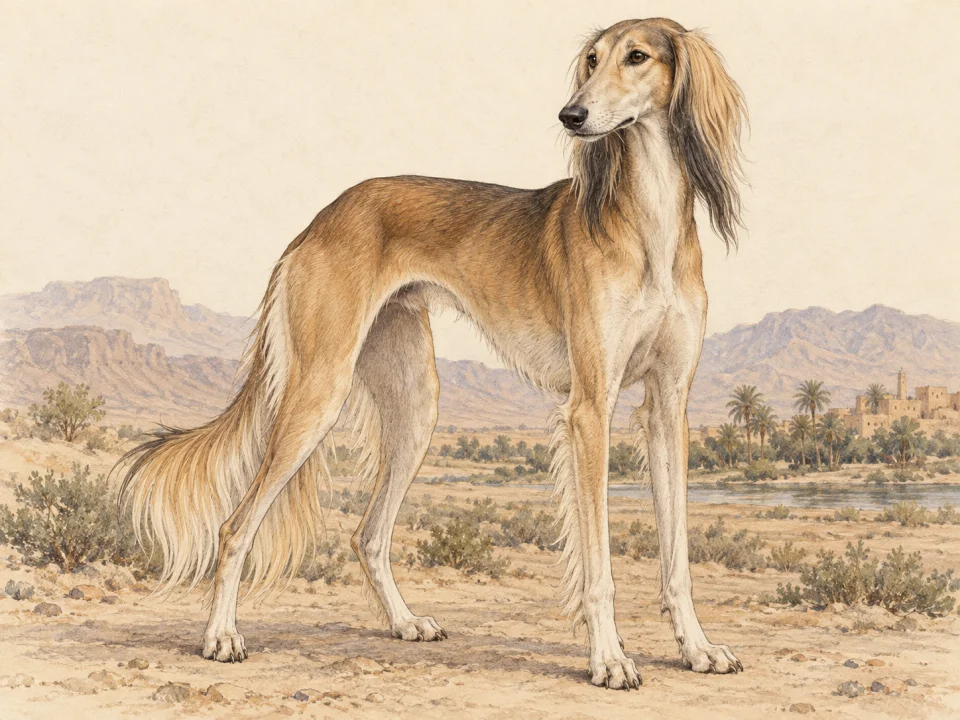
The official standard recognizes a smooth variety without feathering; a smooth Saluki is not a feathered dog whose coat has been clipped. The distinction matters when comparing photographs or discussing grooming with a prospective breeder. Ask to see adult relatives of the puppy and to learn which coat they have. For a feathered dog, include the ears and tail when demonstrating the care it accepts; the breed club notes that these areas may need extra brushing to prevent mats. Avoid choosing solely from a dramatic show photograph. Find out what the coat looks like between grooming sessions and how its care will fit into your own routine. Both varieties still need comfortable handling for nails, teeth and veterinary examinations.[2]
Do not interpret a thyroid number in isolation
The breed club notes that some Salukis have lower thyroid hormone values than dogs of other breeds. This is a reason to ask your veterinarian about interpretation, not a reason to diagnose hypothyroidism yourself or dismiss symptoms. The club’s January 2018 statement advises consultation with professionals familiar with Saluki or sighthound norms when a thyroid condition is suspected. Bring the actual laboratory report and the reason testing was requested to that discussion. Its current health page also identifies cardiac concerns and discusses screening; ask what examinations the individual dog and its parents have had, with dates and findings. A claim that the breed is generally hardy cannot replace those records or establish that a particular dog is free of inherited disease.[3]
Frequently asked questions
Is good recall enough for off-leash walks in an open area?
It is not a substitute for secure containment. The Saluki Club of America warns that pursuit makes unsafe off-leash areas unsuitable. Practice recall, but choose enclosed exercise space and manage entrances.
Source [1]Can a purebred Saluki have no ear or tail feathering?
Yes. The official standard includes a smooth variety without feathering. Lack of feathering alone does not mean the dog is a mix or has been clipped.
Source [2]Does a low thyroid result automatically mean my Saluki needs medication?
No. The club notes that some Salukis have lower values than other dogs. Your veterinarian should interpret the report in context and may consult a professional familiar with sighthound thyroid norms. Do not start or stop medication on breed information alone.
Source [3]Why do Saluki lifespan estimates differ between guides?
The 10–17-year range in our quick facts comes from AKC’s overview; the Saluki Club of America gives 10–14 years on its breed overview and notes that some live longer in its ownership guide. These are broad descriptions from different sources, not a prediction for your dog. Plan for lifelong care and discuss the individual’s health and family history with your veterinarian.
Source [4]FAQ sources
- Saluki Club of America — Living with a Saluki ↗FAQ reference 1
- AKC — Official Saluki standard ↗FAQ reference 2
- Saluki Club of America — January 2018 health statement ↗FAQ reference 3
- Saluki Club of America — Breed overview ↗FAQ reference 4
Sources & methodology
Breed-level measurements and comparison scores provide context. They do not predict an individual dog's health, behaviour or suitability. Open the original publisher pages below to verify the facts and compare any later updates.
- Saluki Club of America — Living with a Saluki ↗Reference 1 · reviewed 2026-09-27
- AKC — Official Saluki standard ↗Reference 2 · reviewed 2026-09-27
- Saluki Club of America — Health ↗Reference 3 · reviewed 2026-09-27
- Saluki Club of America — January 2018 health statement ↗Reference 4 · reviewed 2026-09-27
- Saluki Club of America — Breed overview ↗Reference 5 · reviewed 2026-09-27
- American Kennel Club — Saluki overview ↗Reference 6 · reviewed 2026-09-27
Make it about your dog
Build a profile around your dog's age, experiences and everyday needs.
Meet your dog →Explore local care