
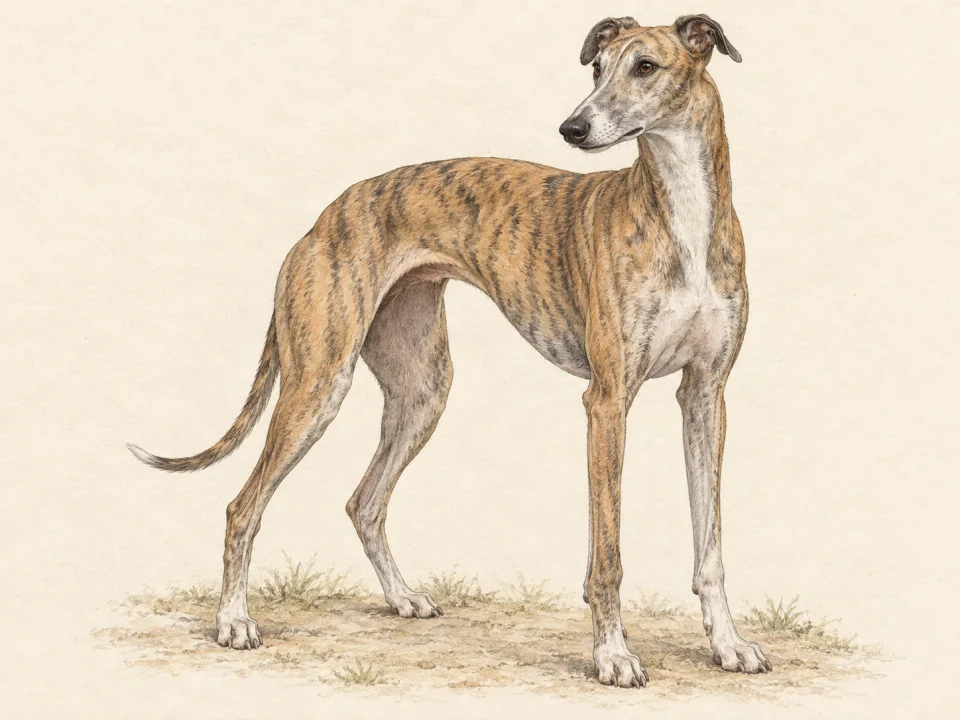
Resting quietly does not establish off-leash safety
AKC describes a sighthound capable of switching from lounging to rapid pursuit when something catches its attention. Plan off-leash activity only in a securely fenced space; do not use an apparently empty field to find out whether recall survives a moving distraction. Before unclipping, inspect the enclosure and agree with companions who controls the gate. Choose activity suitable for the dog’s health and conditioning rather than treating racing ability as a daily sprint requirement. A walk can include gentle training and exploration without provoking chase. At home, introduce handling with the same patient approach: speed and athleticism do not justify rough training. Ask for help if the equipment fit or your ability to manage an exit is uncertain.[1]
Describe your other pets before choosing a dog
The Greyhound Trust asks people with cats or other small pets to discuss them with the homing team so it can consider suitable individuals. That is a matching conversation, not a promise that the breed is always compatible or never compatible. Give a complete picture: which animals live indoors, how rooms are separated and who will supervise. Ask what observations are available for the particular dog and what introduction support the organization provides. Prepare separation before arrival rather than letting animals meet freely to see what happens. A report about one setting should not be treated as permission for every situation, especially outdoors. The same individual approach applies to daily routine: discuss time alone, visitors and the dog’s previous living arrangements instead of assuming that every Greyhound has the same experience.[2]
Keep breed information attached to veterinary records
IDEXX publishes Greyhound-specific reference intervals for SDMA and creatinine, measurements used in kidney assessment. This is a reason to make sure the veterinary team has the correct breed and prior laboratory reports, not a reason to dismiss an abnormal result yourself. Ask whether the laboratory’s reference interval is appropriate and how the result compares with earlier measurements and the examination. The diagnostic update also discusses urine testing as part of assessment. Keep dated results together so a new clinician can see trends rather than a single number without context. A breed-related difference and an illness can coexist; interpretation belongs with the veterinarian.[3]
Frequently asked questions
Can a calm Greyhound still run after a small animal?
Yes. AKC describes strong visual pursuit behavior even in a dog that lounges quietly indoors. Use secure boundaries and controlled handling rather than relying on its resting demeanor.
Source [1]Must every household with a cat rule out adopting a Greyhound?
The Greyhound Trust considers suitable individuals and asks adopters to discuss cats and small pets before matching. Obtain guidance for the specific dog and prepare secure separation; suitability is not guaranteed by a breed label.
Source [2]FAQ sources
- American Kennel Club — Greyhound ↗FAQ reference 1
- Greyhound Trust — All About Greyhounds ↗FAQ reference 2
Sources & methodology
Breed-level measurements and comparison scores provide context. They do not predict an individual dog's health, behaviour or suitability. Open the original publisher pages below to verify the facts and compare any later updates.
- American Kennel Club — Greyhound ↗Reference 1 · reviewed 2026-09-27
- Greyhound Trust — All About Greyhounds ↗Reference 2 · reviewed 2026-09-27
- IDEXX — Greyhound Specific Reference Intervals ↗Reference 3 · reviewed 2026-09-27
Make it about your dog
Build a profile around your dog's age, experiences and everyday needs.
Meet your dog →Explore local care