
Make tooth changes part of the puppy’s care record
Retained baby teeth are a particular concern in small dogs. VCA advises a veterinary appointment when a permanent tooth appears alongside a baby tooth that has not fallen out. Do not wait for an arbitrary age or try to pull it out yourself. Ask your veterinarian to demonstrate a gentle mouth check, and note changes between visits without forcing the puppy’s mouth open. A dated photograph, if comfortably obtained, can help you explain what you noticed. Tell the vet about discomfort with eating or handling rather than assuming every change is normal teething. Build home dental care gradually using the technique and products your veterinarian recommends. A small mouth does not make dental assessment optional, and a clean-looking tooth surface does not answer every dental question.[2]
Match the grooming routine to the actual variety
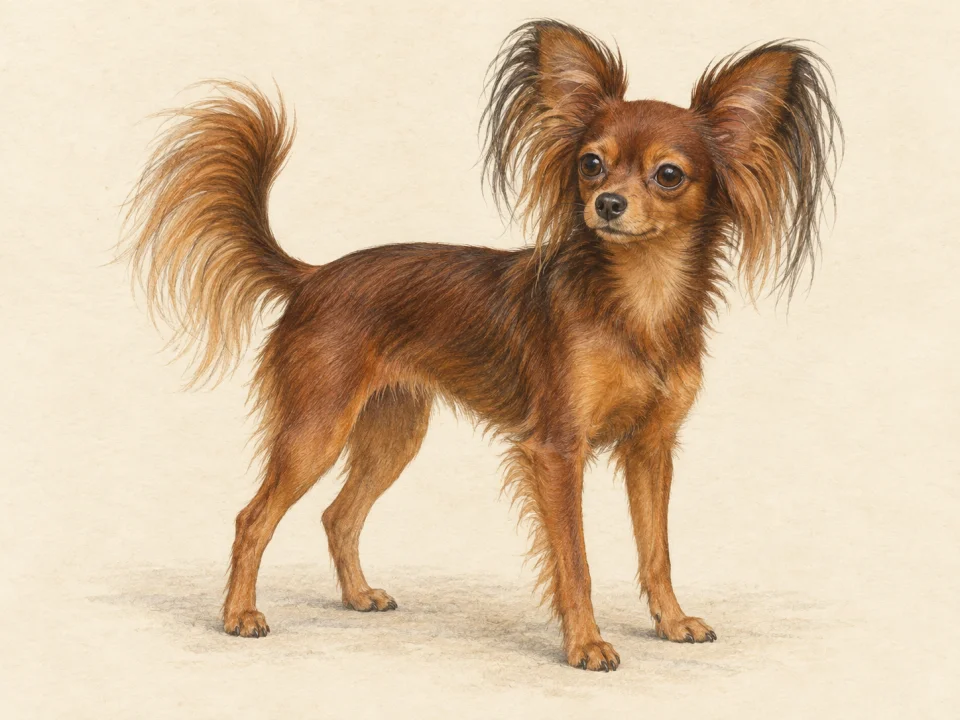
AKC describes smooth coats without the long fringe and longhaired dogs with furnishings on the ears and limbs. The longhaired puppy’s adult fringe develops gradually, so a young dog need not look like a fully mature show photograph. Check the fine furnishings for caught debris and tangles, supporting the hair rather than pulling against the ear. Ask an experienced groomer to demonstrate the technique. For walks, AKC recommends attaching the leash to a harness. Check its fit on the individual, including whether the dog could slip backward out of it, and reassess as a puppy grows. At home, supervise play with larger dogs and teach children to interact at floor level instead of treating a very small companion as something to carry around casually.[1]
Separate a puppy examination from parental screening
AKC lists patella, cardiac and specialist eye evaluations for the Russian Toy. When considering a litter, request the actual findings and dates for each parent and ask what examination history comes with the puppy. A routine puppy checkup and a parent’s specialist screening are different pieces of information. Keep copies under the correct dog’s identity so your veterinarian can review gaps or ambiguous wording. For an adopted adult with incomplete records, state what is unknown and plan an individual assessment instead of assuming that no recorded problem means no problem exists. Small size is not a reason to skip those questions.[3]
Frequently asked questions
Should I wait if an adult tooth grows beside a baby tooth?
Arrange a veterinary examination. VCA identifies that pattern as a possible retained baby tooth. Do not try to remove it at home or wait for a fixed birthday before asking for advice.
Source [1]Should a longhaired puppy already have full ear fringes?
Not necessarily. AKC describes the coat and fringe developing with maturity. Judge grooming needs from the coat present now, rather than expecting a puppy to match an adult photograph.
Source [2]Which parent health records should I ask for?
AKC lists patella, cardiac and specialist eye evaluations. Ask for dated findings identifying each parent, and discuss unclear or missing information with your veterinarian.
Source [3]FAQ sources
- VCA Animal Hospitals — Why does my puppy still have baby teeth? ↗FAQ reference 1
- American Kennel Club — Russian Toy care ↗FAQ reference 2
- American Kennel Club — Toy group health testing requirements ↗FAQ reference 3
Sources & methodology
Breed-level measurements and comparison scores provide context. They do not predict an individual dog's health, behaviour or suitability. Open the original publisher pages below to verify the facts and compare any later updates.
- American Kennel Club — Russian Toy care ↗Reference 1 · reviewed 2026-09-27
- VCA Animal Hospitals — Why does my puppy still have baby teeth? ↗Reference 2 · reviewed 2026-09-27
- American Kennel Club — Toy group health testing requirements ↗Reference 3 · reviewed 2026-09-27
Make it about your dog
Build a profile around your dog's age, experiences and everyday needs.
Meet your dog →Explore local care