
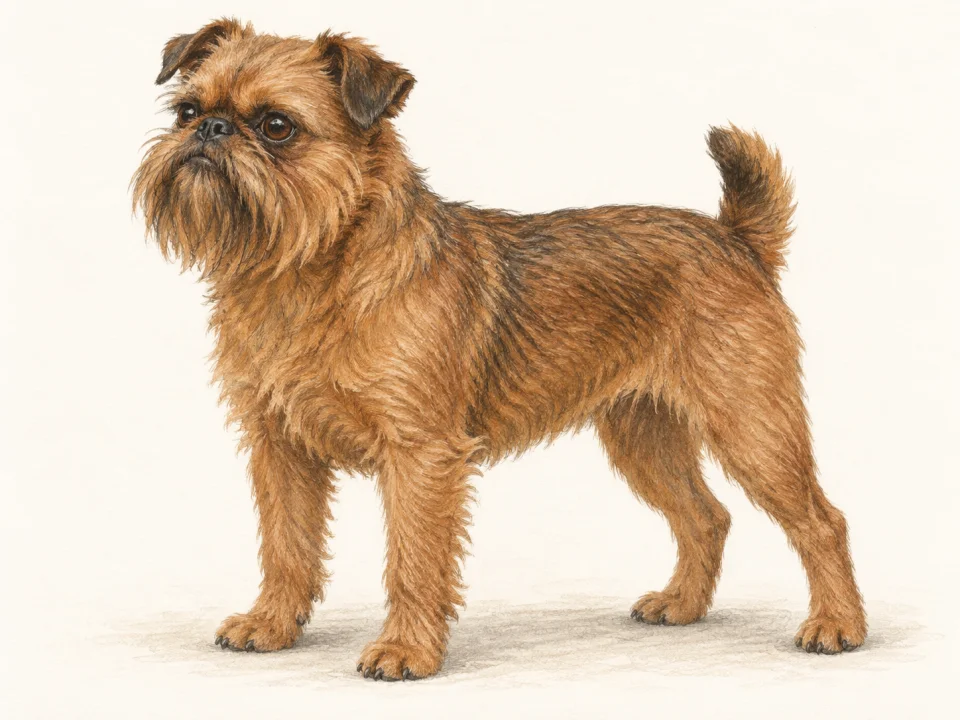
Choose a companion routine, not just a small dog
AKC describes a dog that bonds closely with its person and may struggle when regularly left alone for long periods. Before choosing a Griffon, map a normal workday and the help available during absences. Ask how the individual currently copes with separation. Small size makes transport convenient, but it does not eliminate the need for company, practice and predictable care.[1]
Make house-training clear and patient
The cited guidance notes that house-training may take additional time and effort. Use a consistent routine, recognize opportunities for success and reward promptly. Avoid harsh corrections, which are a poor fit for the breed’s sensitivity. A simple household record of outings and successes can help caregivers coordinate instead of each assuming someone else already provided the next opportunity.[1]
Match grooming to smooth or rough coat
The smooth variety generally needs weekly brushing, increasing during shedding periods. A rough coat requires a different maintenance discussion; ask a groomer to demonstrate a suitable approach and explain clipping options. Do not assume the two coats require identical work, or interpret lower shedding as an allergy guarantee. Both varieties need regular nail care and comfortable handling around the face.[1]
Adapt activity to the short muzzle and weather
AKC warns that flat-faced Griffons can have breathing difficulty in hot or humid conditions. Plan moderate activity around the individual and weather, with opportunities to rest comfortably. A willingness to keep playing is not proof that continuing is safe. Discuss noisy breathing or reduced tolerance with a veterinarian rather than dismissing every concern as a normal feature of the breed.[1]
Set rules for gentle play
A Griffon can be lively, but AKC cautions against roughhousing because of its small size and sensitive nature. Children should learn calm interaction under direct adult supervision, with a resting space the dog can use undisturbed. Keep play at a level where both can disengage. Being sturdy for a toy dog does not make accidental handling or a fall harmless.[1]
Check the scope of orthopedic and eye screening
The cited recommended panel lists patella, hip and ophthalmologist evaluations. Ask for identifiable reports and veterinary interpretation; the broader health discussion also mentions heart concerns, so ask what was assessed rather than assuming one panel covers everything. AKC lists a reference lifespan of 12–15 years. Ongoing changes in movement, vision or exercise tolerance still need attention regardless of that range.[1]
Frequently asked questions
Are smooth and rough Brussels Griffons groomed the same way?
No. Smooth coats need brushing, especially during shedding, while rough-coat maintenance should be discussed with an experienced groomer. Nail and other routine care remain necessary for both.
Source [1]Is a Griffon a good roughhousing playmate for young children?
AKC cautions against that match. Small size and sensitivity call for gentle, directly supervised interaction and an undisturbed resting place.
Source [1]Can a Griffon exercise normally in hot, humid weather?
Heat and humidity can create breathing difficulties for this flat-faced breed. Adapt activity to conditions and the individual, and seek veterinary advice about breathing concerns.
Source [1]Which evaluations are in the cited health panel?
Patella, hip and ophthalmologist evaluations are listed. Request the reports and ask what additional concerns were assessed rather than assuming the panel establishes complete health clearance.
Source [1]FAQ sources
Sources & methodology
Breed-level measurements and comparison scores provide context. They do not predict an individual dog's health, behaviour or suitability. Open the original publisher pages below to verify the facts and compare any later updates.
- American Kennel Club — Brussels Griffon breed and care guidance ↗Reference 1 · reviewed 2026-09-27
Make it about your dog
Build a profile around your dog's age, experiences and everyday needs.
Meet your dog →Explore local care