
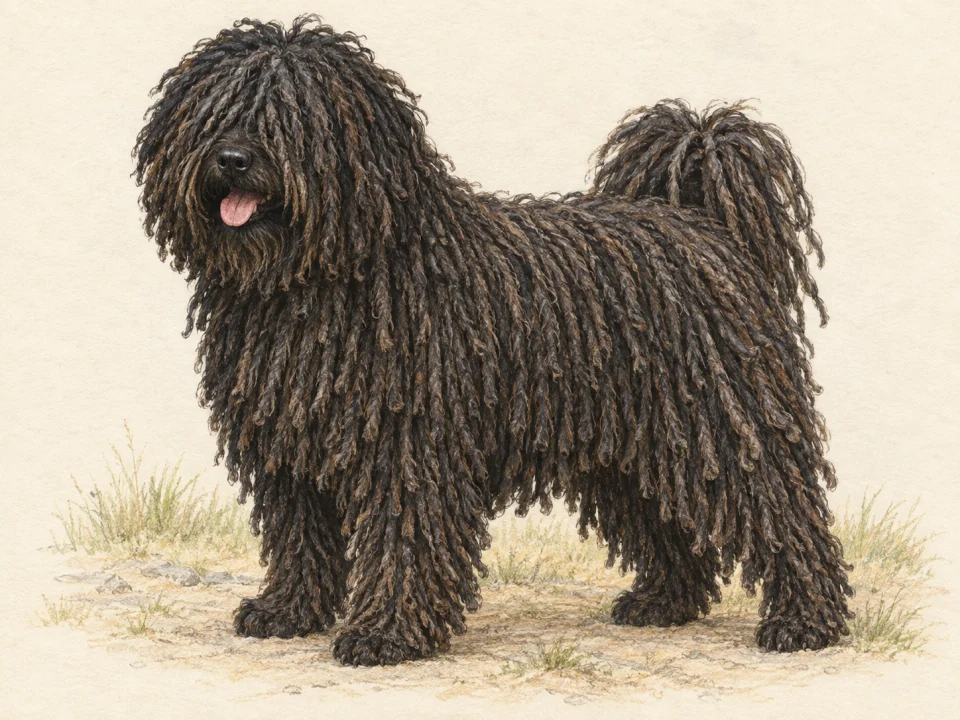
Choose a coat plan before the cords develop
Cording is a natural interaction between the Puli’s two coat layers, but maintaining separate cords requires care. Leaving the coat untouched is not the same as allowing healthy cords to form. The Puli Club of America also describes a brushed coat as an option; AKC includes clipping. Ask a breeder or groomer experienced with Pulik to demonstrate the approach you intend to use on a dog at a comparable coat stage. Before committing, establish who will check the skin, manage developing tangles and notice when the method needs adjusting. Photograph the demonstrated result for your own reference and arrange a follow-up rather than assuming one lesson will cover every stage. If another person provides holiday care, make sure they understand your chosen approach instead of automatically brushing through established cords.[1]
Treat drying as part of the bath, not an afterthought
The club’s coat-care article emphasizes complete drying and notes that coats differ in density and cord structure. A wet outer surface does not tell you how much moisture remains within the coat. Plan a bath for a time when you can finish the whole process, with clean towels, suitable drying arrangements and someone available to monitor the dog. Ask an experienced Puli groomer to show you how to check the deeper coat without pulling at the skin. Do not rely on a fixed drying time copied from another dog. For a practical trial, record when washing finished, which areas remained damp and what your groomer recommends changing next time. An appointment described simply as a bath may not include the cord maintenance or drying your dog needs, so agree the service in advance.[2]
Read the health results behind the certificate
AKC lists hip, patella, eye and degenerative myelopathy evaluations among Puli health screening topics. Request the actual records for the parents rather than only a statement that they have CHIC numbers. OFA explains that a CHIC number means the required tests were completed and made public; it does not mean every result was normal. The requirements can change, while an older CHIC number remains valid. Match the registered dog and identification to the records, note the dates and discuss the findings with your veterinarian. This is particularly useful when an advertisement says only “health tested”: ask which conditions were assessed and what each result means for the planned mating. Screening is useful evidence, not a promise that a puppy will never develop disease.[3]
Frequently asked questions
Do Puli cords need to be braided?
No. The coat layers naturally form cords. They need appropriate separation and maintenance so neighboring cords do not merge into larger mats; get a hands-on demonstration rather than treating the coat as a braiding project.
Source [1]Can every Puli coat dry in the same amount of time?
No. Coat density, cord structure and conditions differ. Learn how to check complete drying on your own dog instead of using another owner’s timetable.
Source [2]Does a CHIC number mean all the health tests were normal?
No. OFA explicitly distinguishes completion and public disclosure of the required tests from normal results. Read the individual reports and their dates.
Source [3]Is coat care the Puli’s only major daily need?
No. AKC describes a dog needing mental as well as physical activity. Include learning and appropriate exercise in the household plan; grooming alone does not meet those needs.
Source [4]FAQ sources
- Puli Club of America — Puli overview ↗FAQ reference 1
- Puli Club of America — Coat care, Puli News February 2007 ↗FAQ reference 2
- Orthopedic Foundation for Animals — CHIC program policies ↗FAQ reference 3
- American Kennel Club — Puli care information ↗FAQ reference 4
Sources & methodology
Breed-level measurements and comparison scores provide context. They do not predict an individual dog's health, behaviour or suitability. Open the original publisher pages below to verify the facts and compare any later updates.
- Puli Club of America — Puli overview ↗Reference 1 · reviewed 2026-09-27
- Puli Club of America — Coat care, Puli News February 2007 ↗Reference 2 · reviewed 2026-09-27
- Orthopedic Foundation for Animals — CHIC program policies ↗Reference 3 · reviewed 2026-09-27
- American Kennel Club — Puli care information ↗Reference 4 · reviewed 2026-09-27
Make it about your dog
Build a profile around your dog's age, experiences and everyday needs.
Meet your dog →Explore local care