
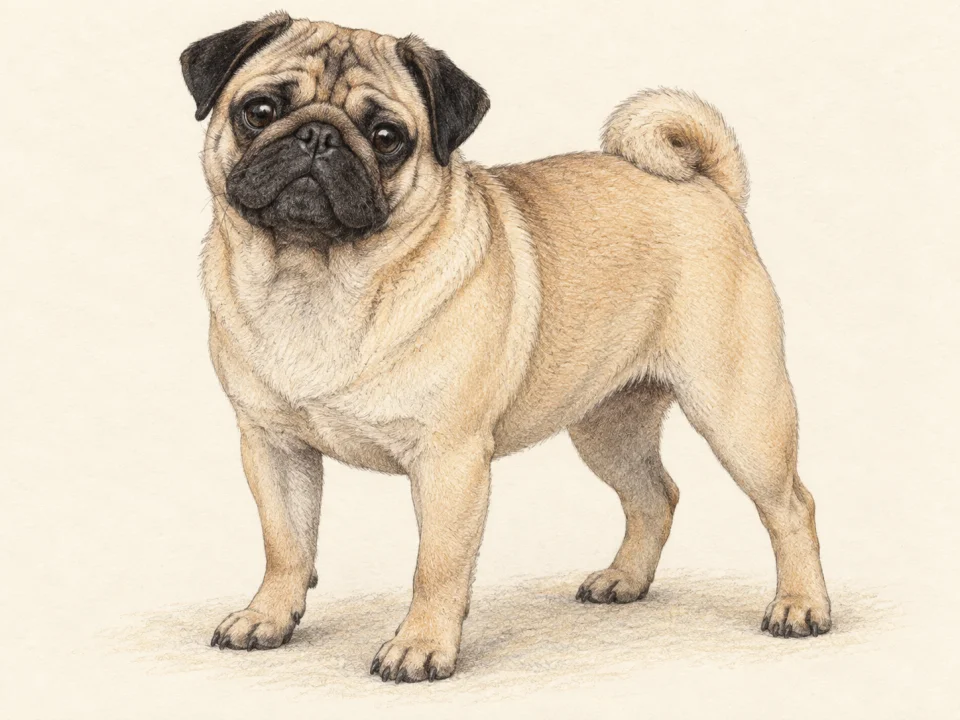
Understand the companion temperament
AKC describes Pugs as outgoing, affectionate, adaptable and strongly motivated by human company. Many suit indoor and family life, but an individual still needs daily movement, learning, rest and gradual exposure to ordinary experiences.[1]
Put breathing and heat safety first
PDSA identifies the Pug as a severely brachycephalic breed with elevated health and welfare risks, including breathing difficulty. Avoid strenuous activity and hot, humid conditions, choose cooler times for walks and watch the dog continuously. Collapse, blue or grey gums, severe distress or struggling to breathe requires emergency veterinary care.[2]
Use the individual dog to set exercise
Pugs benefit from regular moderate movement, but duration and pace must reflect breathing, temperature, age, weight and veterinary guidance. Several short outings can be safer than a single hard session. Stop for noisy or laboured breathing, lagging, weakness or distress.[2]
Manage food and body condition deliberately
AKC notes that Pugs can be highly food-motivated and prone to weight gain. Measure meals and training rewards together, use low-calorie enrichment when appropriate and ask a veterinary professional to assess body condition. Weight change can also have medical causes and should not be managed by guesswork.[1]
Check eyes, folds, skin and ears
AKC highlights the breed's prominent eyes as vulnerable, while PDSA describes eye and skin risks linked to conformation. Keep folds clean and dry according to veterinary guidance and seek assessment for squinting, redness, discharge, odour, pain, cloudiness or persistent scratching.[2]
Train with rewards and calm repetition
AKC recommends positive methods for this sensitive, people-oriented breed. Teach practical skills in short sessions and reinforce calm choices. Early socialisation should mean safe, positive exposure with room to retreat, rather than forcing contact.[1]
Build comfortable time apart gradually
Pugs were developed as companions and may find long isolation difficult. Begin with brief, comfortable separations and build only while the dog remains relaxed. Persistent vocalising, destruction, toileting or panic deserves veterinary and qualified behaviour support.[1]
Choose health and function over appearance
When considering a puppy or rescue, ask about breathing at rest and during movement, veterinary history, eyes, skin, mobility and documented health screening. Meet the individual more than once where possible. Wrinkles and a very short face should never be treated as more important than comfortable breathing and ordinary movement.[2]
Frequently asked questions
What are some useful facts about Pugs?
AKC traces the breed to ancient China, where Pugs were developed as companions. Their long-standing social role helps explain the modern breed's people-oriented temperament, while the short face creates care needs that a prospective home must assess seriously.
Source [1]What behaviours are common in Pugs?
AKC describes Pugs as outgoing, playful, adaptable, affectionate and eager to be with their people. Breed tendencies do not predict every individual, so evaluate behaviour in context and ask about the dog's actual history.
Source [2]What should you ask before bringing home a Pug?
Ask how the individual breathes at rest and during ordinary exercise, how it handles heat, what health screening and veterinary records exist, and what support the breeder or rescue provides. Also ask about temperament, time alone, skin, eyes, mobility and current body condition.
Source [3]What common problems should Pug homes understand?
PDSA warns that brachycephalic conformation can be associated with serious breathing, eye and skin problems. AKC also highlights heat intolerance, vulnerable eyes and weight gain. This is risk information, not a diagnosis; discuss the individual dog with a veterinarian.
Source [3]FAQ sources
- American Kennel Club — Pug history ↗FAQ reference 1
- American Kennel Club — is the Pug right for you? ↗FAQ reference 2
- PDSA — Pug breed information ↗FAQ reference 3
Sources & methodology
Breed-level measurements and comparison scores provide context. They do not predict an individual dog's health, behaviour or suitability. Open the original publisher pages below to verify the facts and compare any later updates.
- American Kennel Club — is the Pug right for you? ↗Reference 1 · reviewed 2026-09-09
- PDSA — Pug breed information ↗Reference 2 · reviewed 2026-09-09
- American Kennel Club — Pug history ↗Reference 3 · reviewed 2026-09-09
Make it about your dog
Build a profile around your dog's age, experiences and everyday needs.
Meet your dog →Explore local care