
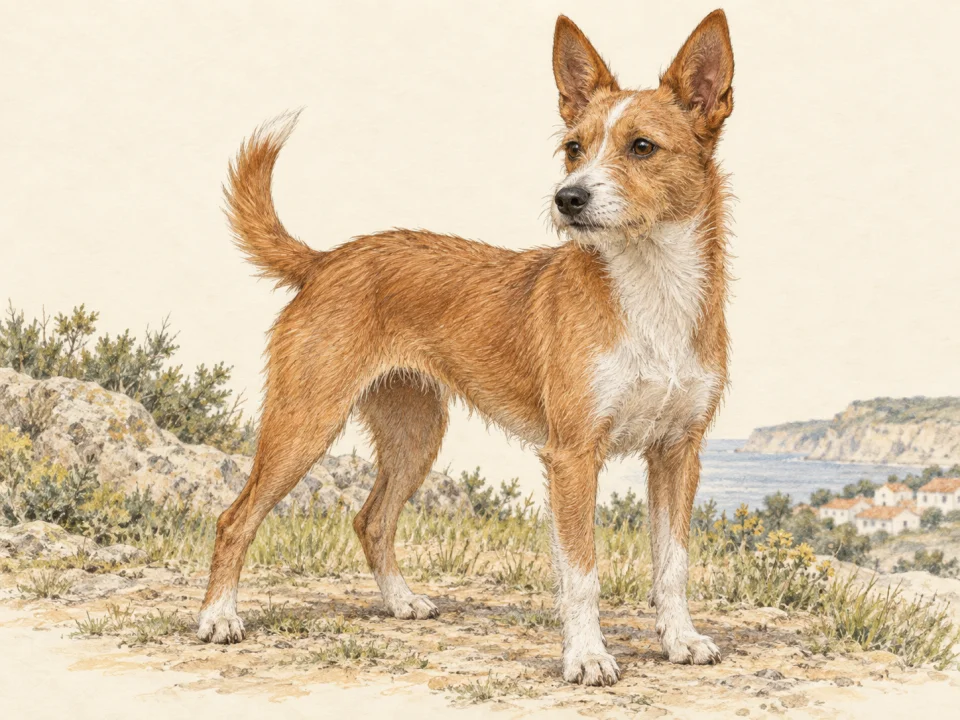
Check the enclosure from a small hunter’s perspective
The breed standard describes a rabbit hunter working through rocks and dense vegetation, alone or in a small pack. Its compact size helps explain why a yard that contains a larger dog may still have openings worth investigating. Walk the fence line and inspect low gaps, drains and spaces beside gates before allowing free exploration. Supervise the first outings and secure the dog before anyone opens an exit. AKC recommends allowing the Pequeno loose only in safely fenced areas because following a scent can quickly lead to trouble. Build recall practice into those controlled sessions, but do not treat a good response indoors as proof the dog will abandon a rabbit trail. Provide activity suited to the individual, with time to investigate as well as time to engage with you.[1]
Keep the natural coat manageable and training brief
The AKC standard describes two coats without undercoat: short and dense in the smooth variety, longer and harsh with a beard in the wire variety. AKC’s care guidance recommends routine brushing and a comb check for wire-coat tangles; routine clipping or scissoring is not required. Have a groomer show you how to handle the beard and other areas comfortably rather than pulling a comb through a knot. Use those everyday tasks as short training opportunities: reward a moment of standing or a calm touch, then finish while participation is still comfortable. This fits AKC’s advice to keep training positive, enjoyable and brief. Include nail and dental care in the plan even if the body coat looks clean. Small size makes equipment selection important, too: check fit as a puppy grows instead of keeping the first harness indefinitely.[2]
Read the orthopedic and eye records separately
AKC recommends patella, hip and ophthalmologist evaluations for the Pequeno. The parent-club statement hosted by AKC distinguishes an OFA hip evaluation from the alternative PennHIP evaluation, and lists a separate specialist eye examination and OFA patella evaluation. When speaking to a breeder, make three entries for each parent: hips, eyes and patellas. Under each, note the identified dog, examination method, date and result. A reassuring answer about one joint does not establish that the other evaluation occurred. Likewise, a general puppy examination is not the same record as a parent’s specialist eye assessment. The hosted statement uses older eye-registry terminology, so confirm current procedures with the club or OFA rather than treating its wording as a current application checklist. Keep the original reports for your veterinarian; these checks inform a decision without promising a disease-free puppy.[3]
Frequently asked questions
How big is a Portuguese Podengo Pequeno under the AKC standard?
The standard gives 8–12 inches at the shoulder and 9–13 pounds. These identify the small variety; use an individual body-condition assessment when making feeding decisions.
Source [1]Does the wirehaired Pequeno have an undercoat?
The AKC Pequeno standard describes both smooth and wire varieties as without undercoat. Do not transfer coat descriptions from a different Podengo size or registry without checking the source.
Source [1]Is a Pequeno a low-energy lapdog because it is small?
No. AKC describes an energetic rabbit hunter needing regular activity. Choose secure walks, exploration, play and training suitable to its age and condition rather than relying on size to predict exercise needs.
Source [2]Are hip and patella checks interchangeable for a Pequeno?
No. The published club statement lists them separately, alongside a specialist eye examination. Request identifiable results for each parent rather than accepting a single “joints checked” assurance, and confirm current screening procedures with the club.
Source [3]FAQ sources
Sources & methodology
Breed-level measurements and comparison scores provide context. They do not predict an individual dog's health, behaviour or suitability. Open the original publisher pages below to verify the facts and compare any later updates.
- American Kennel Club — Portuguese Podengo Pequeno standard ↗Reference 1 · reviewed 2026-09-27
- American Kennel Club — Portuguese Podengo Pequeno care ↗Reference 2 · reviewed 2026-09-27
- Portuguese Podengo Pequenos of America — health statement hosted by AKC ↗Reference 3 · reviewed 2026-09-27
Make it about your dog
Build a profile around your dog's age, experiences and everyday needs.
Meet your dog →Explore local care