
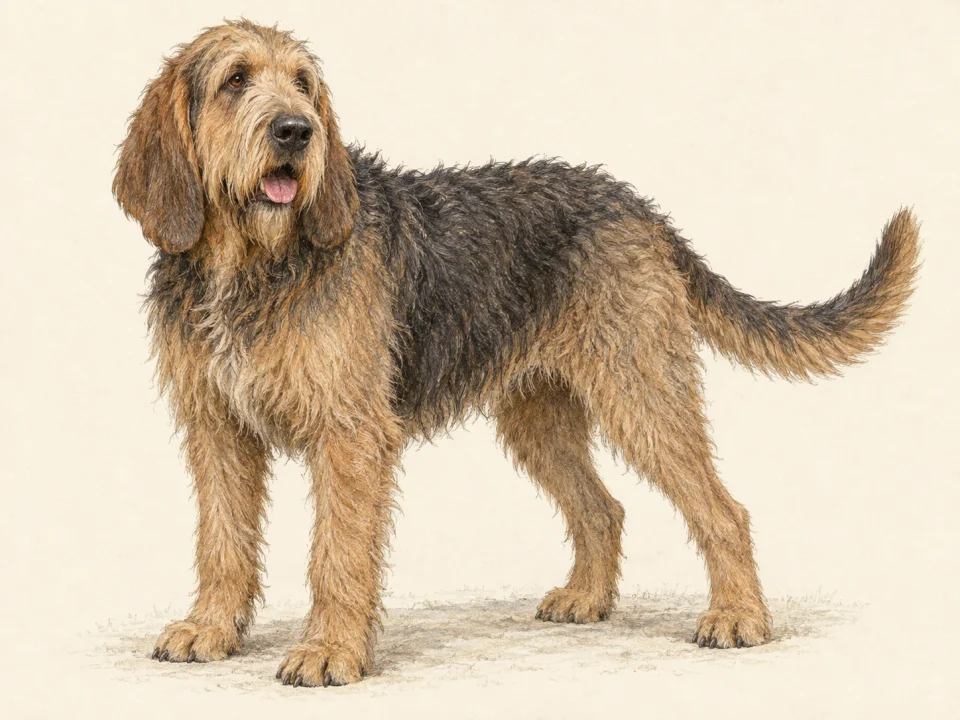
Give the nose an outing without handing over control
The American parent club warns that an interesting scent can override an Otterhound’s response to its owner, making off-leash walks a poor choice. Plan routes where the dog can investigate smells while remaining safely attached to its handler. Before a new walker takes over, show them the equipment, entrances and places where you stop to let the dog sniff. Do not assume a large yard supplies its own exercise: AKC notes that some hounds simply rest there. Shared walks and appropriate training give the dog something to do with you. Include the breed’s substantial voice in your household planning, too. Ask to hear adult dogs and discuss the actual living arrangement with the breeder or rescue, especially when walls and outdoor space are shared with neighbors.[2]
Keep the shaggy coat clean without styling away its character
AKC recommends brushing according to coat length and texture and points out that the beard can collect debris and food. A useful home setup is a washable place near the entrance, towels and the grooming tools your groomer has demonstrated. Check the beard after meals and inspect the coat after muddy outings; explain this routine to anyone caring for the dog while you are away. Natural-looking does not mean unattended. The standard calls for a rough outer coat and water-resistant undercoat rather than a sculpted finish. Ask a groomer to show how to check through the coat without pulling, and seek help for tangles you cannot handle comfortably. Being bred for work in water also does not establish that every location or swimming session is safe for an individual dog.[1]
Put the bleeding-disorder result in the veterinary record
Auburn University describes Glanzmann thrombasthenia as an inherited defect in platelet function. Affected dogs can bleed excessively following injury or surgery; gum and nose bleeding can also occur. A DNA test can identify affected dogs and carriers of the Otterhound mutation. Ask the breeder for the named result and arrange for your veterinarian to interpret it alongside the dog’s history. Keep the report with the records supplied before a planned procedure, rather than mentioning only that the dog had a genetic panel. The laboratory distinguishes the Otterhound mutation from the one described in Great Pyrenees, so check that the report concerns the appropriate test. Unusual bleeding needs veterinary attention regardless of what a genetic result says; do not use this description to diagnose its cause at home.[3]
Frequently asked questions
Is recall training enough for an off-leash Otterhound walk?
Do not rely on it as the only safeguard. The parent club specifically warns that following a scent may take priority over responding to the owner. Use secure containment and suitable walking equipment even while practicing recall.
Source [1]Must every male Otterhound weigh 115 pounds?
No. The AKC standard explicitly calls its size figures guidelines rather than absolutes and gives balance and soundness greater importance. Assess your dog’s body condition with your veterinarian instead of feeding to reach that number.
Source [2]Is Glanzmann thrombasthenia just a low platelet count?
The Auburn description concerns defective platelet function: the platelets do not stick together normally. Let a veterinarian interpret bleeding signs and laboratory findings rather than assuming a platelet count alone answers the question.
Source [3]FAQ sources
- Otterhound Club of America — Owner information, 2022 ↗FAQ reference 1
- American Kennel Club — Otterhound standard ↗FAQ reference 2
- Auburn University — Glanzmann Thrombasthenia in Otterhounds ↗FAQ reference 3
Sources & methodology
Breed-level measurements and comparison scores provide context. They do not predict an individual dog's health, behaviour or suitability. Open the original publisher pages below to verify the facts and compare any later updates.
- American Kennel Club — Otterhound care ↗Reference 1 · reviewed 2026-09-27
- Otterhound Club of America — Owner information, 2022 ↗Reference 2 · reviewed 2026-09-27
- Auburn University — Glanzmann Thrombasthenia in Otterhounds ↗Reference 3 · reviewed 2026-09-27
- American Kennel Club — Otterhound standard ↗Reference 4 · reviewed 2026-09-27
Make it about your dog
Build a profile around your dog's age, experiences and everyday needs.
Meet your dog →Explore local care