
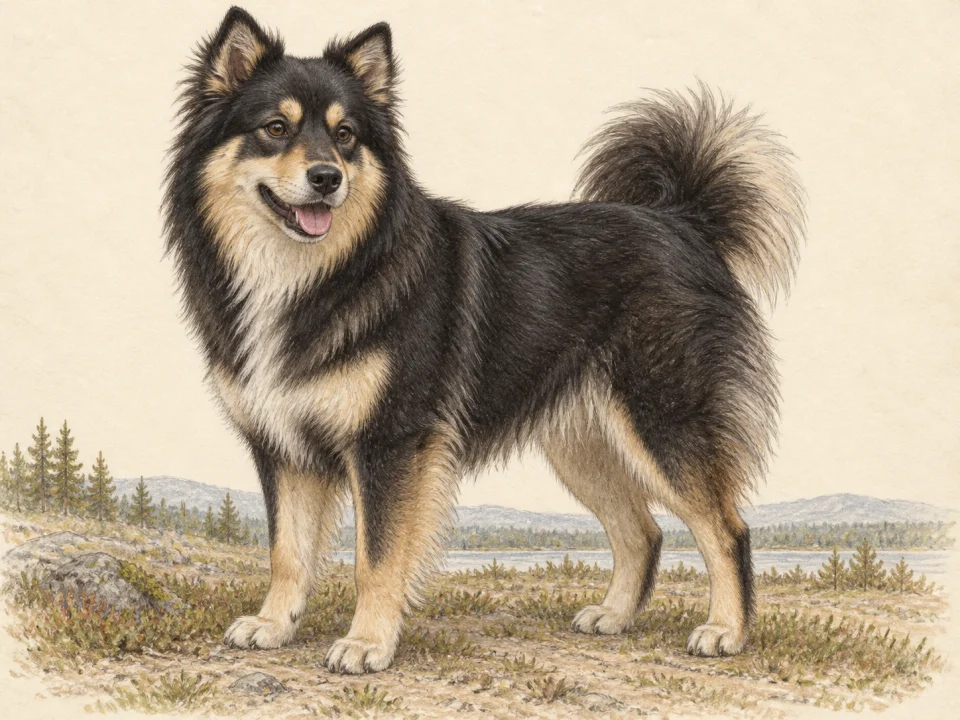
Related history does not make this a Finnish Lapphund
The FCI’s March 2026 standard records the Lapponian Herder’s separation as its own breed in December 1966, after it and the Finnish Lapphund had previously shared registration. It describes a muscular herding spitz with a body longer than its shoulder height and a tail that does not curl over the back. The outer coat is straight and harsh, over a dense undercoat. These details help distinguish the breeds when researching care or talking to a breeder. The standard also explicitly describes ready barking during work. That is context for choosing a home and planning training, not a promise that every individual will bark the same amount.[1]
Choose a job your household can actually provide
AKC describes a dog that benefits from exercise, enrichment and learning, with possibilities including obedience, rally and nose work. You do not need a herd of reindeer, but you do need a realistic way to engage the dog beyond simply leaving it outside. Before adoption, identify one activity you can sustain on ordinary weekdays and a quieter alternative when weather or your schedule changes. If shared walls or nearby neighbors make sound especially consequential, discuss the individual dog’s vocal behavior before committing. Note what starts barking, the setting and how readily the dog settles; use that information with a qualified trainer rather than expecting a longer walk to solve every cause. AKC also describes seasonal undercoat shedding once or twice a year. Allow time for that change even though the coat may look less elaborate than that of some other northern breeds. Neither a working label nor a straightforward-looking coat makes the dog maintenance-free.[2]
Frequently asked questions
Is the Lapponian Herder the same breed as the Finnish Lapphund?
No. The FCI records separate recognition for the Lapponian Herder in 1966. Shared reindeer-herding history does not make their breed descriptions interchangeable.
Source [1]Is barking part of the Lapponian Herder’s working background?
Yes. The FCI standard specifically describes barking readily while working. Assess the actual dog and your living situation; that history neither guarantees silence at home nor explains every barking problem.
Source [1]FAQ sources
- FCI — Lapponian Herder standard No. 284, March 2026 ↗FAQ reference 1
Sources & methodology
Breed-level measurements and comparison scores provide context. They do not predict an individual dog's health, behaviour or suitability. Open the original publisher pages below to verify the facts and compare any later updates.
- FCI — Lapponian Herder standard No. 284, March 2026 ↗Reference 1 · reviewed 2026-09-27
- American Kennel Club — Lapponian Herder ↗Reference 2 · reviewed 2026-09-27
Make it about your dog
Build a profile around your dog's age, experiences and everyday needs.
Meet your dog →Explore local care