
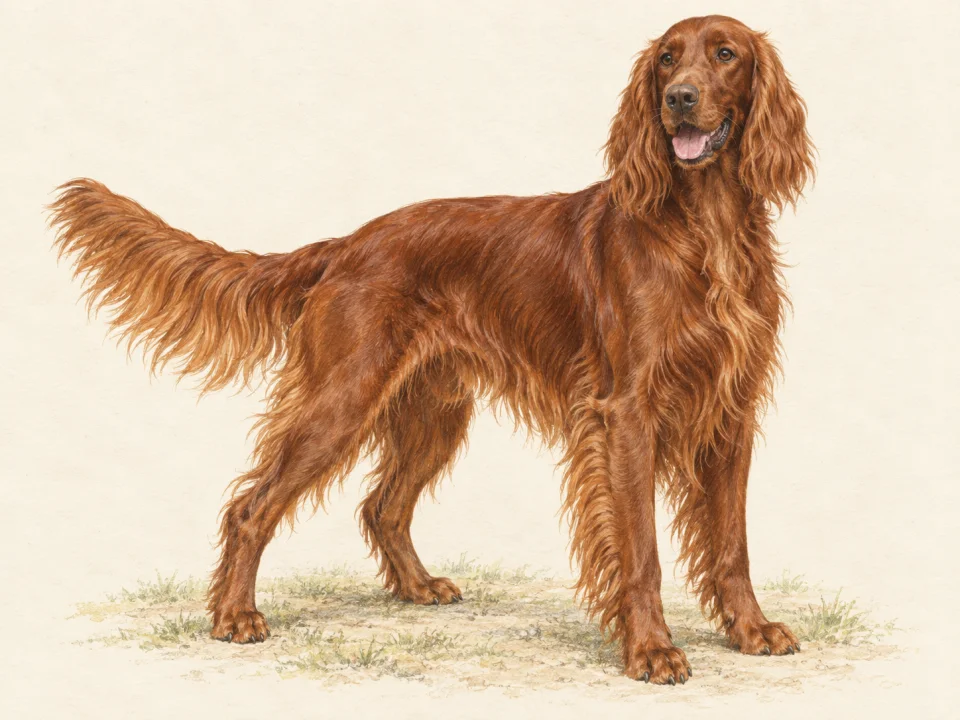
Make greeting manners part of the family plan
AKC describes an outgoing, energetic dog that learns best with positive, rewarding training. Enjoying people does not automatically teach an Irish Setter how to approach a child or someone carrying shopping. Choose a clear greeting routine and practice it in manageable situations before expecting it at a busy doorway. Give visitors space and supervise interactions rather than relying on the breed’s friendly reputation. Shared walks, play and suitable learning activities should be a regular part of the plan; tiring the dog out is not a substitute for teaching. The coat also needs recurring attention: AKC recommends brushing at least twice weekly. Use those sessions to check for developing tangles and changes in skin or comfort. Ask a groomer to demonstrate handling of longer hair so that maintenance stays gentle and does not become a struggle after knots have tightened.[1]
A PRA report needs a subtype
UC Davis identifies rcd1-PRA in Irish Setters as an early-onset inherited retinal condition caused by a PDE6B variant. Its explanation distinguishes a carrier with one copy from a dog with two copies. For a prospective puppy, ask to see the actual parental results and the variant tested rather than accepting an unspecific statement that the family is PRA clear. Have a veterinarian explain unfamiliar findings. A DNA result is inherited information about that test, not a substitute for assessment of a dog with a new visual problem.[2]
Why rcd1 and rcd4 should not be merged in your records
The laboratory separately describes rcd4-PRA, a later-onset form found in some affected Irish Setters without the rcd1 variant. Keep the names separate when collecting reports; one test does not answer the question addressed by the other. A useful record lists the dog’s identity, laboratory, test name, result and date, alongside clinical eye examination findings. Discuss current screening recommendations with the breed club and veterinarian. If your dog begins hesitating in familiar spaces or otherwise appears to have a vision change, arrange an examination instead of using a clear result for one variant to rule out every eye problem.[3]
Frequently asked questions
Does being an rcd1-PRA carrier mean the dog has that disease?
UC Davis describes a one-copy carrier as unaffected by this inherited form, while the result matters for breeding decisions. It does not rule out other eye conditions.
Source [1]Are rcd1-PRA and rcd4-PRA the same test?
No. UC Davis describes distinct variants and different typical onset patterns. Check the exact test name on each report and seek professional advice about what screening is appropriate.
Source [2]FAQ sources
- UC Davis Veterinary Genetics Laboratory — PRA in Irish Setters ↗FAQ reference 1
- UC Davis Veterinary Genetics Laboratory — rcd4-PRA ↗FAQ reference 2
Sources & methodology
Breed-level measurements and comparison scores provide context. They do not predict an individual dog's health, behaviour or suitability. Open the original publisher pages below to verify the facts and compare any later updates.
- American Kennel Club — Irish Setter ↗Reference 1 · reviewed 2026-09-27
- UC Davis Veterinary Genetics Laboratory — PRA in Irish Setters ↗Reference 2 · reviewed 2026-09-27
- UC Davis Veterinary Genetics Laboratory — rcd4-PRA ↗Reference 3 · reviewed 2026-09-27
Make it about your dog
Build a profile around your dog's age, experiences and everyday needs.
Meet your dog →Explore local care