
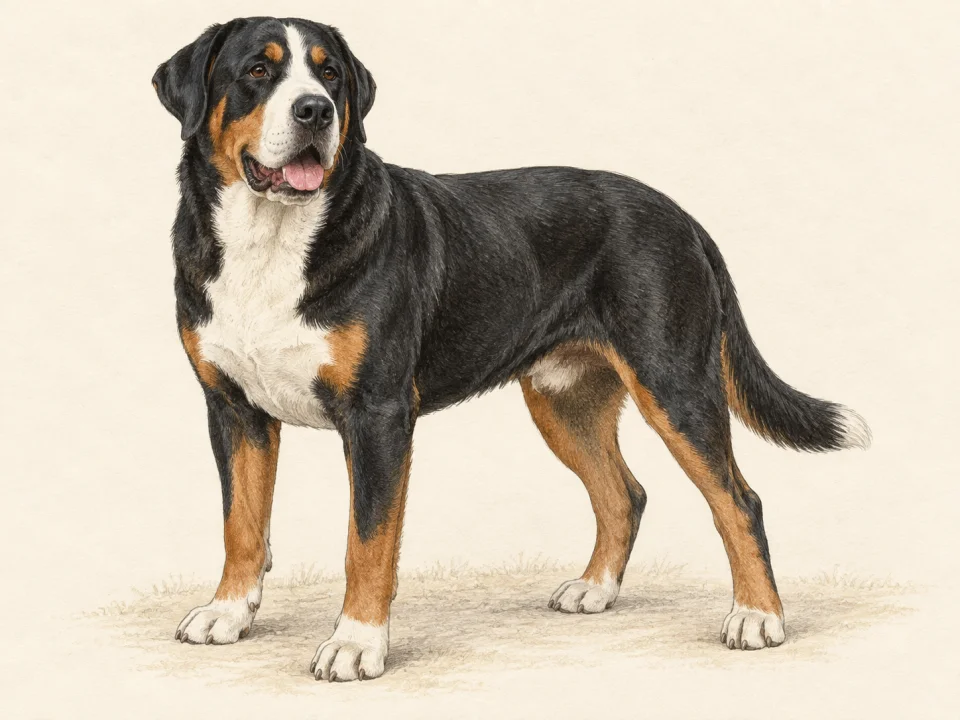
A draft background is not a ready-made exercise plan
Swissies historically worked as herders and draft dogs. That background explains their strength; it does not tell you a safe load, distance or starting age for your own dog. If carting interests you, obtain instruction and veterinary guidance before adding weight, and learn the equipment and handling skills first. For everyday life, practice walking, waiting at exits and cooperative care without relying on physically overpowering the adult. AKC describes moderate exercise needs rather than an ideal marathon-running partner. Choose outings for the individual’s condition and comfort, with room to shorten them. Coat care is another place where appearances can mislead: the smooth-looking coat has an undercoat that sheds. Ask for a demonstration of suitable tools so that seasonal loose hair is removed comfortably instead of repeatedly scraping the skin.[1]
Separate urinary leakage from a training problem
The breed club notes urinary incontinence in young female Swissies as well as spayed females, with males less commonly affected. Involuntary leakage should prompt a veterinary discussion rather than punishment or an assumption that house training failed. Record whether wetness appears during rest, whether normal urination has changed and when the problem began. These observations help the appointment without establishing a diagnosis. The club lists several possible causes, including urinary infection and anatomical or neurological problems, so a familiar breed tendency is not enough to select a treatment. Have medication and surgical history available. Discuss sterilization decisions individually with your veterinarian; a general association does not predict what will happen to a particular dog.[2]
An abdominal emergency is not always stomach torsion
The GSMDCA explains that splenic torsion can occur on its own or alongside gastric dilatation-volvulus. Sudden collapse with abdominal pain is an emergency: contact an emergency veterinarian and seek care immediately. More gradual illness also needs prompt veterinary advice rather than home attempts to distinguish spleen from stomach problems. Tell the clinician the breed, symptoms and timing, along with any previous abdominal surgery. The relevant practical preparation is knowing how to transport a large dog and which clinic can receive it. Do not delay departure to complete a symptom checklist or assume that an absence of classic bloat signs excludes another serious abdominal condition.[3]
Frequently asked questions
Can urinary incontinence affect a young female Swissy?
Yes. The breed club reports it in growing females as well as spayed adults. Arrange veterinary assessment of leakage rather than assuming it is deliberate or simply a training failure.
Source [1]Can a Swissy have splenic torsion without GDV?
Yes. GSMDCA describes primary splenic torsion occurring without stomach torsion. Acute collapse or abdominal pain requires urgent veterinary care, not a home diagnosis.
Source [2]FAQ sources
Sources & methodology
Breed-level measurements and comparison scores provide context. They do not predict an individual dog's health, behaviour or suitability. Open the original publisher pages below to verify the facts and compare any later updates.
- American Kennel Club — Greater Swiss Mountain Dog ↗Reference 1 · reviewed 2026-09-27
- Greater Swiss Mountain Dog Club of America — Urinary Incontinence ↗Reference 2 · reviewed 2026-09-27
- Greater Swiss Mountain Dog Club of America — Splenic Torsion ↗Reference 3 · reviewed 2026-09-27
Make it about your dog
Build a profile around your dog's age, experiences and everyday needs.
Meet your dog →Explore local care