
Choose a working partner, not a police-dog image
The Dutch Shepherd’s farm background includes guarding, moving livestock and other work; AKC also describes modern roles in sport, tracking and search and rescue. Those examples explain versatility, not what every puppy will become. A useful selection conversation starts with the work of the parents and the life of the particular dog. Ask for examples of an ordinary day, including what happens between activities. A spectacular training video does not show how a dog behaves when guests enter, when its handler is occupied or when the day’s plans change. Meet the dog in an appropriate everyday setting when possible. For a puppy, discuss why the breeder considers that pairing suitable for your experience and intended activities rather than relying on a description such as “high drive.”[1]
Identify the coat variety before booking grooming
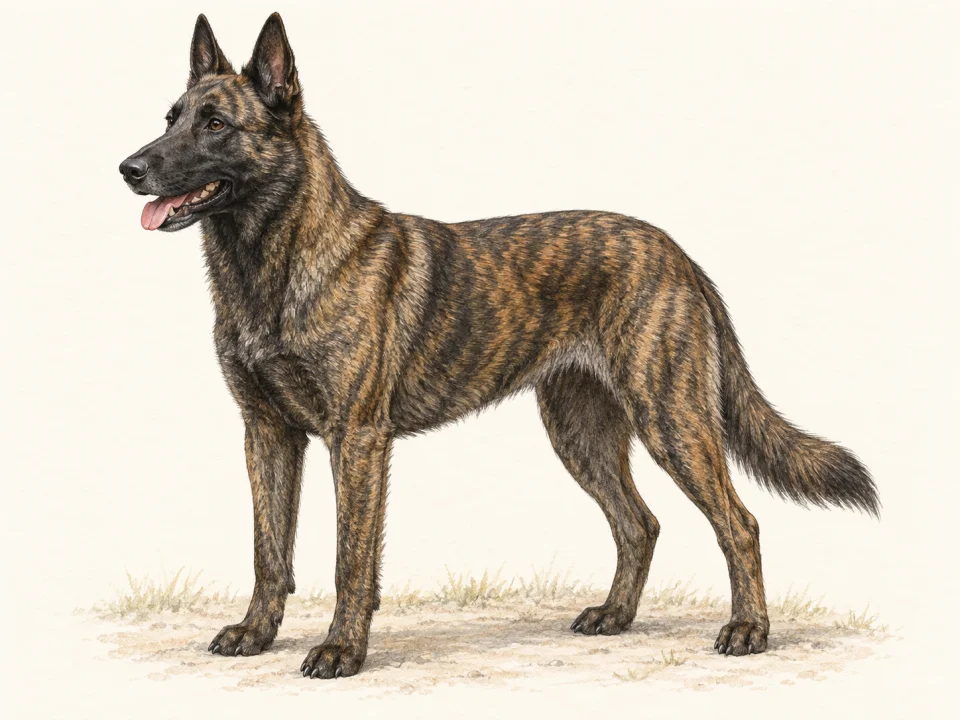
The official standard recognizes short, long and rough coats. Short hair still has undercoat; long hair is straight, with more coat around the neck, hindquarters and tail. The rough variety has a harsh, tousled coat, beard and eyebrows, and its brindling can look less distinct. The standard describes hand-plucking roughly twice yearly for this variety. That is a reason to seek someone experienced with the coat, not instructions to pull hair from an uncomfortable dog yourself. When arranging care, give the groomer the variety as well as the breed name and ask what maintenance you should do between visits. A single grooming score cannot communicate these differences.[2]
Read the screening record by variety and by date
The ADSA’s October 2024 statement recommends hip assessment, elbow evaluation and annual eye screening from one year of age for breeding dogs. It also lists additional recommendations: thyroid testing and von Willebrand disease type I testing for long-haired dogs, and two named cerebellar ataxia DNA tests for short-haired dogs, as well as degenerative myelopathy testing. These are different investigations, not interchangeable versions of a general “health tested” claim. Request the actual result, the dog’s identity and the examination date. Ask a veterinarian to explain any result or missing item before interpreting it as reassurance. The linked statement concerns breeding-stock screening; it is not an individualized testing schedule for every pet, nor a promise that tested parents will produce a dog free of disease.[3]
Plan a learning task, not endless repetitions
AKC’s training guidance favors short sessions with mentally engaging work over excessive repetition. For an owner, that suggests choosing a small, observable goal for a session instead of repeatedly running through an entire routine. For example, plan one easy search with a clear start and finish, then note whether the dog understood it and could return to rest. This is an example of planning a lesson, not a breed-specific exercise prescription. Use an instructor to match the activity and difficulty to the dog. If your only available outlet is unstructured physical exertion, resolve that gap before taking on a dog whose appeal is its working ability. Time for learning, handling and recovery belongs in the plan alongside walks.[1]
Frequently asked questions
Are all Dutch Shepherds short-haired?
No. The standard recognizes short-haired, long-haired and rough-haired varieties. The coat variety changes the grooming conversation; the rough coat has specific hand-plucking guidance.
Source [1]Does a DNA panel replace Dutch Shepherd hip, elbow and eye screening?
No. The ADSA statement lists these assessments separately from DNA tests. Obtain the individual reports and ask a veterinarian to explain their scope.
Source [2]Does working-dog ancestry guarantee a suitable family pet?
No. Working roles describe breed history and potential. Assess the individual dog, its upbringing and the routine your household can actually provide.
Source [3]FAQ sources
- Official Dutch Shepherd Standard, effective 2017 ↗FAQ reference 1
- American Dutch Shepherd Association — Health Statement, October 2024 ↗FAQ reference 2
- American Kennel Club — Dutch Shepherd ↗FAQ reference 3
Sources & methodology
Breed-level measurements and comparison scores provide context. They do not predict an individual dog's health, behaviour or suitability. Open the original publisher pages below to verify the facts and compare any later updates.
- American Kennel Club — Dutch Shepherd ↗Reference 1 · reviewed 2026-09-27
- Official Dutch Shepherd Standard, effective 2017 ↗Reference 2 · reviewed 2026-09-27
- American Dutch Shepherd Association — Health Statement, October 2024 ↗Reference 3 · reviewed 2026-09-27
Make it about your dog
Build a profile around your dog's age, experiences and everyday needs.
Meet your dog →Explore local care