
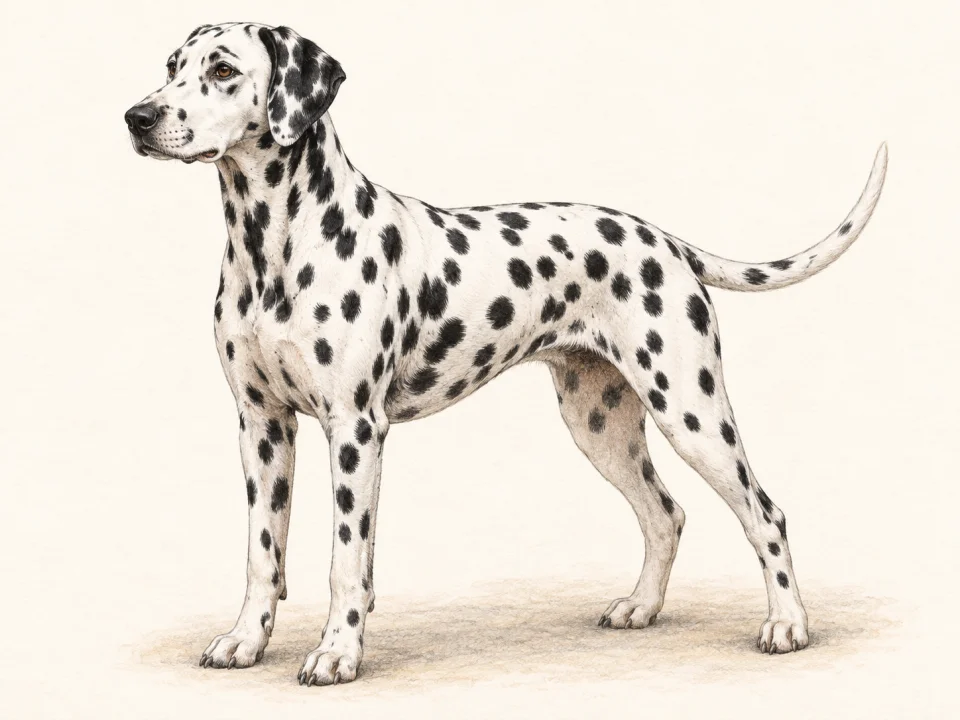
Why lifespan references differ
The AKC lists 11–13 years; the Dalmatian Club of America’s owner handout gives 11–15. These are breed references, not a prediction for your dog. Neither a spotted coat nor an energetic first meeting tells you how long a dog will live. When adopting an adult, ask which veterinary records are available and what ongoing care is needed, rather than choosing between the two ranges as though one were a guarantee.[2]
Ask for the puppy’s own hearing report
The Dalmatian Club of America advises obtaining BAER hearing-test results for puppies. Request the report identifying the puppy you will bring home, not only test results for its parents. Ask your veterinarian to explain the result for each ear; turning toward a noise at a visit does not replace that report. If hearing loss is documented, discuss communication and safe supervision before collection. A useful question for the current carer is which visual cues the dog already understands, so the new household can use them consistently.[2]
Build urinary care into the handover
Urinary stones are an important Dalmatian health concern, but a breed label does not establish whether an individual has stones or which diet it needs. Review any previous stone analyses and veterinary instructions before changing food or adding supplements. For a sitter, write down the prescribed food, access to fresh water, usual toilet opportunities and emergency contact. Suspected inability to pass urine needs urgent veterinary attention; do not wait for a food change to help. This handover is an organizational aid, not a treatment plan.[2]
A short coat still leaves hair around the house
Dalmatians shed throughout the year. The short, smooth coat therefore means less coat styling, not a hair-free sofa. The AKC recommends weekly brushing with a horsehair mitt or rubber curry comb to remove loose hair. Before adoption, handle the dog with its current carer and ask to see its brushing routine: this reveals both the tool used and how comfortably the dog accepts it. Plan washable covers where the dog rests and regular cleaning of those areas. Brushing manages loose hair; it does not stop shedding.[1]
Choose shared activity, not just a large yard
The AKC describes Dalmatians as potentially high-energy dogs that need physical and mental activity. A yard does not by itself provide training or companionship. For a prospective adult dog, ask to join a familiar walk and observe leash handling, recovery after excitement and response to rewards. Use that experience to decide whether your household can sustain the routine. For puppies, discuss age-appropriate activity with your veterinarian rather than starting strenuous running because of the breed’s coaching history. Reward-based practice and pleasant introductions to unfamiliar places are part of the AKC’s training advice.[1]
Frequently asked questions
What is a Dalmatian’s life expectancy?
The AKC gives 11–13 years, while the Dalmatian Club of America’s handout gives 11–15. Neither range predicts an individual dog’s lifespan; its age, health history and current veterinary needs matter when planning care.
Source [1]Is a parent’s hearing test enough when choosing a puppy?
No. Ask for the puppy’s own identifiable BAER report and have the results for each ear explained. The Dalmatian Club of America advises breeders to test their litters and provide the results to owners.
Source [1]Does every Dalmatian need the same urinary diet?
Do not select a restrictive diet or medication from breed advice alone. Discuss the individual dog’s history with a veterinarian and retain any stone-analysis results. Suspected inability to urinate is an emergency, not a reason to try another food first.
Source [1]Do Dalmatians shed despite having short hair?
Yes, they shed year-round. Weekly brushing with an appropriate mitt or rubber curry comb helps remove loose hair, but you should still expect hair on bedding and furniture.
Source [2]Can a Dalmatian puppy immediately become a running partner?
Do not use the breed’s athletic history as clearance for strenuous puppy exercise. Ask your veterinarian about suitable activity for the individual puppy and build reward-based training and pleasant new experiences into daily care.
Source [2]FAQ sources
- Dalmatian Club of America — owner handout ↗FAQ reference 1
- American Kennel Club — Dalmatian ↗FAQ reference 2
Sources & methodology
Breed-level measurements and comparison scores provide context. They do not predict an individual dog's health, behaviour or suitability. Open the original publisher pages below to verify the facts and compare any later updates.
- American Kennel Club — Dalmatian ↗Reference 1 · reviewed 2026-09-27
- Dalmatian Club of America — owner handout ↗Reference 2 · reviewed 2026-09-27
Make it about your dog
Build a profile around your dog's age, experiences and everyday needs.
Meet your dog →Explore local care