
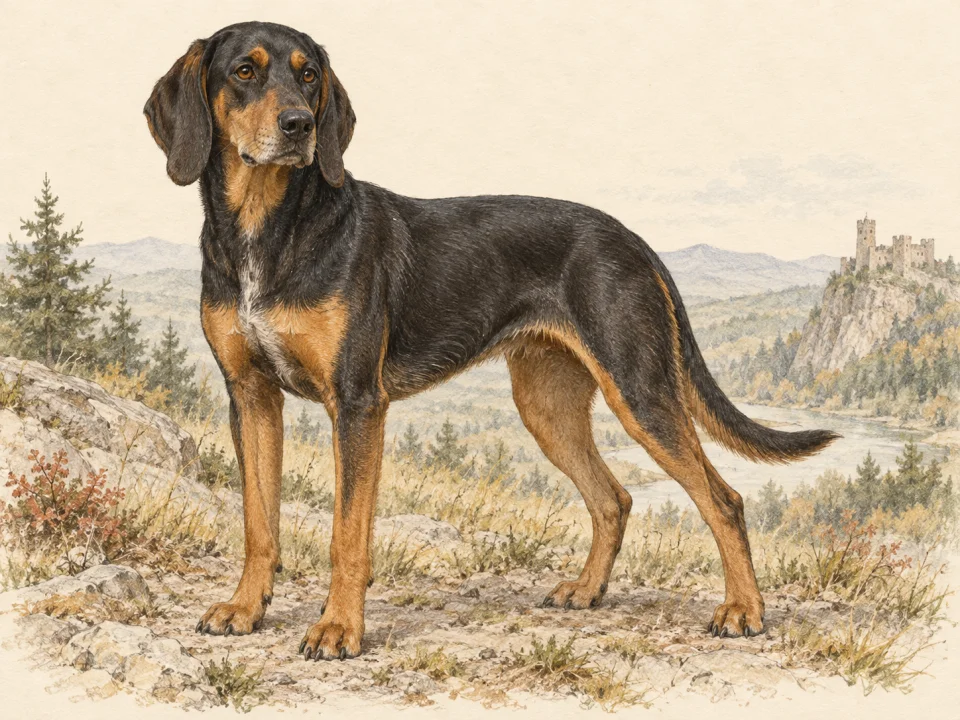
Understand what working independently means at home
The FCI describes a hound able to follow a trail far from its handler and give voice while hunting. A quiet moment in the living room therefore tells you little about its response to fresh scent outdoors. Before choosing one, consider access to places where it can investigate safely, neighbors’ tolerance for a carrying hound voice, and who will check the gate after a delivery. For travel, measure the actual dog rather than assuming the published minimum weight is its full adult size. FCI gives an ideal shoulder height of 55–65 cm and a minimum weight of 25 kg; AKC lists a minimum of 55 pounds. Neither is a maximum or a feeding target. The standard places overall balance ahead of the height measurement alone. Ask your veterinarian about the individual’s body condition instead of trying to meet a number by increasing food.[1]
Plan the route before releasing the lead
AKC cautions that pursuit can outweigh the dog’s response to its owner and recommends securely enclosed areas for off-leash activity. Check an enclosure for gaps and usable exits before treating it as safe. On walks, allow sniffing where you can maintain control and choose a route that gives you room to move away from wildlife or other distractions. Build fitness gradually rather than assuming a breed known for endurance is ready for a long run immediately. The short coat needs straightforward regular brushing, but outdoor activity still leaves paws, ears and skin to check. Ask the breeder about health history and available screening; the source’s broad health description should not be interpreted as proof that this hound has no inherited risks.[2]
Practice returning before a scent becomes the whole task
Use a quiet area to reward the dog for turning toward you and coming a short distance. Gradually introduce manageable distractions while keeping a lead or other secure boundary in place. AVSAB supports reward-based teaching; a dog that is too absorbed to respond needs an easier practice setting, not escalating punishment. A simple search for a hidden toy can provide a controlled outlet for investigation between walks. Keep the search area small at first and finish while the dog is still engaged. The goal is a useful partnership with a scent-driven hound, not proof that training has removed its hunting interest. Continue using physical containment where a failed response could put the dog at risk.[3]
Frequently asked questions
Can a calm Transylvanian Hound still be vocal on a trail?
Yes. The FCI describes a ringing hunting voice. Calm behavior in one setting does not predict silence when the dog becomes interested in scent.
Source [1]Is affection for its owner enough to make off-leash walking reliable?
No. AKC warns that pursuit can take priority. Use a lead outside secure enclosures and continue recall practice without making safety depend on it.
Source [2]How can I use its scenting interest without hunting?
Try a small, supervised toy-search game and reward success. Increase difficulty gradually and keep the area secure; this is enrichment, not a guarantee of recall around wildlife.
Source [3]Will an adult Transylvanian Hound weigh only 55 pounds?
Not necessarily. AKC’s 55-pound figure is a minimum; FCI likewise specifies a minimum of 25 kg, not an upper limit. Measure and weigh the individual when choosing transport equipment, and base feeding decisions on veterinary body-condition assessment rather than that minimum.
Source [1]FAQ sources
- FCI — Transylvanian Hound standard No. 241 ↗FAQ reference 1
- American Kennel Club — Transylvanian Hound care ↗FAQ reference 2
- American Veterinary Society of Animal Behavior — Humane training position ↗FAQ reference 3
Sources & methodology
Breed-level measurements and comparison scores provide context. They do not predict an individual dog's health, behaviour or suitability. Open the original publisher pages below to verify the facts and compare any later updates.
- FCI — Transylvanian Hound standard No. 241 ↗Reference 1 · reviewed 2026-09-27
- American Kennel Club — Transylvanian Hound care ↗Reference 2 · reviewed 2026-09-27
- American Veterinary Society of Animal Behavior — Humane training position ↗Reference 3 · reviewed 2026-09-27
Make it about your dog
Build a profile around your dog's age, experiences and everyday needs.
Meet your dog →Explore local care