
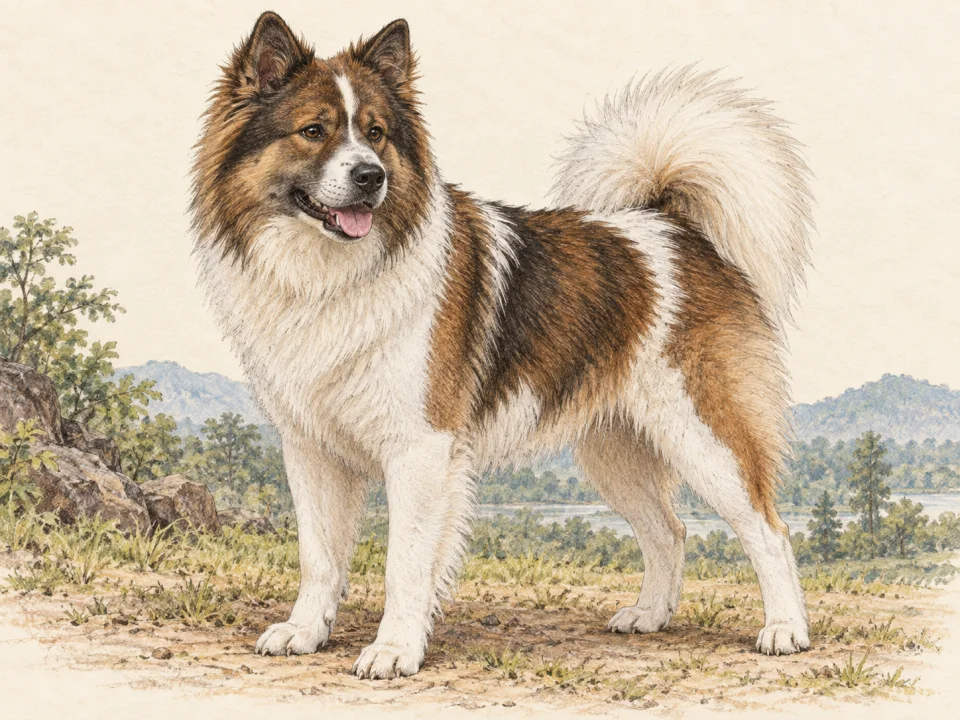
Plan for a watchful companion
The FCI standard gives ideal shoulder-height ranges of 46–55 cm for males and 41–50 cm for females, but no numeric weight range. Its square outline is a proportion guide, not a reason to feed for a bulky appearance. Look at the adult beneath the thick coat and ask your veterinarian about body condition. For daily life, the standard’s description of watchfulness and possible reserve with strangers is more useful than a promise that every Bangkaew is outgoing. Plan where the dog can rest when a delivery arrives or visitors enter, and ask the current carer how this individual responds to unfamiliar people. A quiet space away from the entrance allows a gradual introduction without requiring visitors to reach over the dog or insist on contact.[1]
Make brushing and training manageable together
AKC’s care guidance recommends weekly brushing and notes that cutting-style deshedding tools can damage the outer coat. Ask a groomer to demonstrate how to reach loose undercoat without scraping the skin or removing healthy guard hairs. Use short sessions to build comfort with the neck ruff, hindquarters and tail rather than tackling a neglected coat in one long struggle. The same guidance favors engaging, positive training with limited repetition. A short search game or a new household skill can complement walks. Outdoors, use a lead or secure enclosure: interest in wildlife and independent exploration can matter even when the dog responds well indoors. A successful lesson in a quiet room is not proof of reliable recall around a moving animal.[2]
An eye examination matters even after a clear DNA panel
The American breed club specifically warns that inherited eye-disease markers are not fully understood in Thai Bangkaews and that eye conditions have occurred in dogs with clear commercial genetic results. Ask for a veterinary ophthalmologist’s examination rather than accepting a DNA panel as a substitute. The club also recommends hip and elbow radiographs, patella evaluation and cardiac assessment alongside routine veterinary care. Keep the examination dates and actual findings with the records so your veterinarian can interpret them. Reports of a condition in some lines do not establish how common it is across the breed. Nor does an absence of family reports prove that an individual is unaffected.[3]
Frequently asked questions
How big is a Thai Bangkaew, and is there a standard weight?
FCI lists ideal shoulder heights of 46–55 cm for males and 41–50 cm for females. It does not set a numeric weight range. The thick coat can obscure body shape, so use the individual dog’s measurements for equipment and veterinary body-condition assessment for feeding decisions.
Source [1]Can I assume good indoor recall will work around wildlife?
No. AKC recommends a lead or fenced area because of the breed’s prey interest and independent nature. Practice gradually with controlled distractions without risking an escape.
Source [2]Does a clear DNA panel rule out eye disease in a Thai Bangkaew?
No. The American breed club explicitly recommends examination by a veterinary ophthalmologist and notes limitations in known genetic markers for the breed.
Source [3]FAQ sources
- FCI — Thai Bangkaew Dog standard No. 358 ↗FAQ reference 1
- American Kennel Club — Thai Bangkaew care ↗FAQ reference 2
- Thai Bangkaew Dog Club of America — Breed health testing ↗FAQ reference 3
Sources & methodology
Breed-level measurements and comparison scores provide context. They do not predict an individual dog's health, behaviour or suitability. Open the original publisher pages below to verify the facts and compare any later updates.
- FCI — Thai Bangkaew Dog standard No. 358 ↗Reference 1 · reviewed 2026-09-27
- American Kennel Club — Thai Bangkaew care ↗Reference 2 · reviewed 2026-09-27
- Thai Bangkaew Dog Club of America — Breed health testing ↗Reference 3 · reviewed 2026-09-27
Make it about your dog
Build a profile around your dog's age, experiences and everyday needs.
Meet your dog →Explore local care