
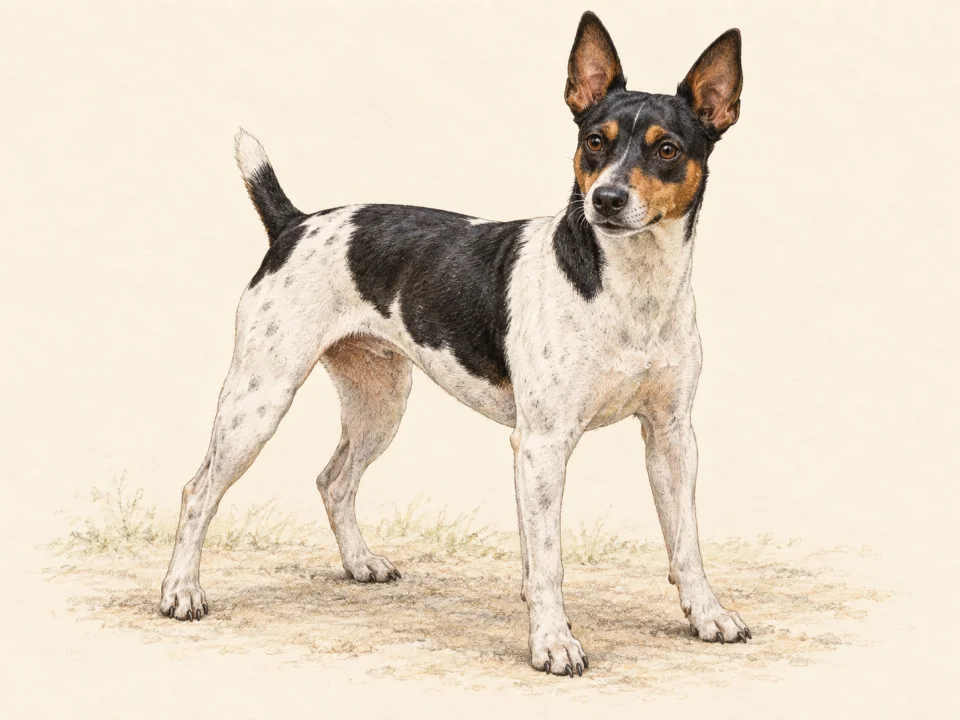
A short-legged terrier, not simply a miniature Rat Terrier
The UKC history describes two Rat Terrier types distinguished primarily by leg length, with the shorter-legged dogs developing into the Teddy Roosevelt Terrier. Its standard emphasizes a balanced, muscular working dog without exaggerated construction. When meeting a prospective puppy or adult, watch it move comfortably rather than choosing the shortest legs or heaviest body available. A breed name does not make an extreme feature desirable. UKC also describes a vocal alert to unfamiliar people or animals. For a home beside a busy walkway, consider where the dog will rest and whether it can watch every passerby; arrange a quieter resting place before barking becomes the household routine.[1]
Give the ratter a safe outlet
AKC describes a strong interest in pursuing small animals, alongside enthusiasm for activities such as scent work. That is a reason to plan secure boundaries and separate access to small pets, not to test whether the dog will leave a caged animal alone. Start with a simple search for a toy or treat in a safe area and let the dog succeed before increasing difficulty. For organized sports, use a suitable introductory class rather than improvising demanding jumps because the dog looks eager. The short coat generally needs weekly brushing to remove loose hair; it still sheds. A small grooming workload leaves room for the more important commitment of walks, teaching and companionship.[2]
Match the screening list to the named breed
AKC’s Teddy Roosevelt Terrier health recommendations list patella evaluation, a cardiac examination, primary lens luxation and chondrodystrophy. Do not substitute a Rat Terrier checklist simply because the breeds share history. Ask the breeder for the specific examination or laboratory report corresponding to each item and have uncertain wording explained. In particular, a statement that a dog has short legs is not itself a genetic test result, and a DNA panel does not replace a clinical knee or heart assessment. Screening informs breeding decisions and identifies particular risks; it does not promise that a puppy will never develop a health problem. Keep the puppy’s own veterinary examination separate from the parents’ screening results.[3]
Frequently asked questions
Is the Teddy Roosevelt Terrier just a small Rat Terrier?
The breeds share ancestry, but the Teddy developed from the short-legged type and has its own standard. Evaluate it as a balanced working terrier rather than selecting for the smallest or most exaggerated body.
Source [1]Does the smooth coat mean a Teddy Roosevelt Terrier will not shed?
No. AKC describes shedding and recommends weekly brushing with a soft brush or suitable grooming mitt. Easy coat care does not remove the need for regular maintenance.
Source [2]Which health screening topics should I discuss with a Teddy breeder?
AKC lists patellas, cardiac examination, primary lens luxation and chondrodystrophy. Ask what was examined or tested, see the individual results, and clarify their limits with a veterinarian.
Source [3]FAQ sources
Sources & methodology
Breed-level measurements and comparison scores provide context. They do not predict an individual dog's health, behaviour or suitability. Open the original publisher pages below to verify the facts and compare any later updates.
- United Kennel Club — Teddy Roosevelt Terrier standard ↗Reference 1 · reviewed 2026-09-27
- American Kennel Club — Is the Teddy Roosevelt Terrier right for you? ↗Reference 2 · reviewed 2026-09-27
- American Kennel Club — National breed club health testing recommendations ↗Reference 3 · reviewed 2026-09-27
Make it about your dog
Build a profile around your dog's age, experiences and everyday needs.
Meet your dog →Explore local care