
Give an unfamiliar person time to become familiar
AKC describes hesitation around strangers and an alert response to arrivals. Ask how the particular dog handles visitors before arranging a busy welcome. Let it observe from a comfortable distance and avoid forcing greetings or handling. Familiarity can develop gradually; the breed’s attachment to known people does not mean a newly adopted dog should immediately accept every member of a social circle.[1]
Choose the individual rather than the outline
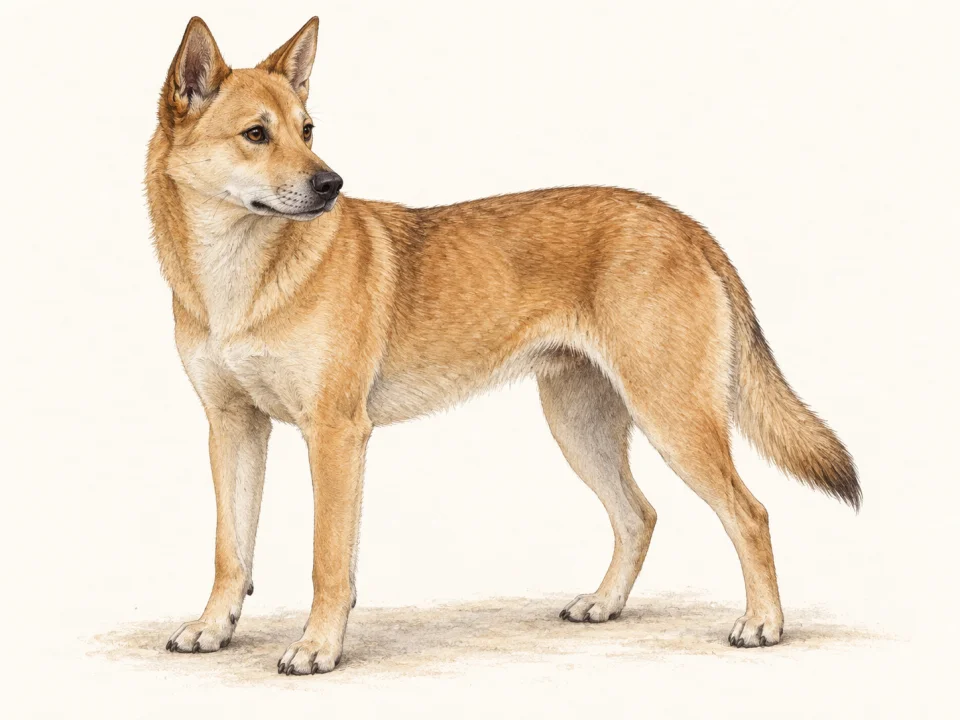
Pointed ears, a fox-like muzzle and a curved tail are among the features described by AKC. A similar-looking mixed-breed dog cannot be identified reliably from those features alone. For a prospective companion, ask for available background records and observe behavior. Practical care decisions should follow what is known about that dog, rather than assumptions based on a resemblance to a dingo or wolf.[1]
Build a moderate daily activity routine
The cited guidance does not describe the Carolina Dog as exceptionally high-energy, but still recommends daily exercise. Suitable walks, secure play and short learning games can make a varied routine. Adapt it to age and health, and observe recovery. Moderate needs do not mean no needs, while the dog’s outdoor appearance does not justify imposing an endurance schedule without preparation.[1]
Find a reward the dog actually values
AKC notes that response to treat training can vary. Observe whether the individual prefers food, play or another appropriate reward in a quiet setting. Keep tasks achievable and reinforce the desired response promptly. If attention falls away, reduce distractions and reassess the setup rather than simply escalating pressure or assuming the dog is incapable of learning the cue.[1]
Adjust brushing to the seasonal coat
The cited coat description includes a denser undercoat in cooler months and variation in length. Brush according to the actual coat, inspect for loose hair and use occasional baths when needed. Include nail care even if the dog tends to keep itself clean. A tidy appearance should not prevent regular gentle handling that helps you notice a new uncomfortable area.[1]
Bring medication questions to the veterinarian
AKC flags possible ivermectin sensitivity in some Carolina Dogs. Tell your veterinarian about the breed background and ask about suitable parasite prevention before administering medication. Do not independently stop prescribed prevention or infer a safe dose from a breed page. The source gives no named screening panel, so request actual health records rather than assuming a general healthy-breed statement establishes clearance.[1]
Frequently asked questions
Should a Carolina Dog greet every visitor immediately?
Not necessarily. AKC describes hesitation around strangers. Provide space and gradual introductions based on the individual’s comfort.
Source [1]Can pointed ears and a curved tail prove a dog is a Carolina Dog?
No. Appearance alone is not reliable breed identification. Use available background records and assess the individual rather than treating resemblance as proof.
Source [1]What if food is not an effective training reward?
Observe what the dog values in a low-distraction setting and consider suitable play or other rewards. Keep the task manageable instead of increasing pressure.
Source [1]What should I ask about parasite medication?
AKC flags possible ivermectin sensitivity in some dogs. Discuss the individual with your veterinarian before administering medication; do not choose a dose or stop prescribed prevention based on this page.
Source [1]FAQ sources
Sources & methodology
Breed-level measurements and comparison scores provide context. They do not predict an individual dog's health, behaviour or suitability. Open the original publisher pages below to verify the facts and compare any later updates.
- American Kennel Club — Carolina Dog breed and care guidance ↗Reference 1 · reviewed 2026-09-27
Make it about your dog
Build a profile around your dog's age, experiences and everyday needs.
Meet your dog →Explore local care