
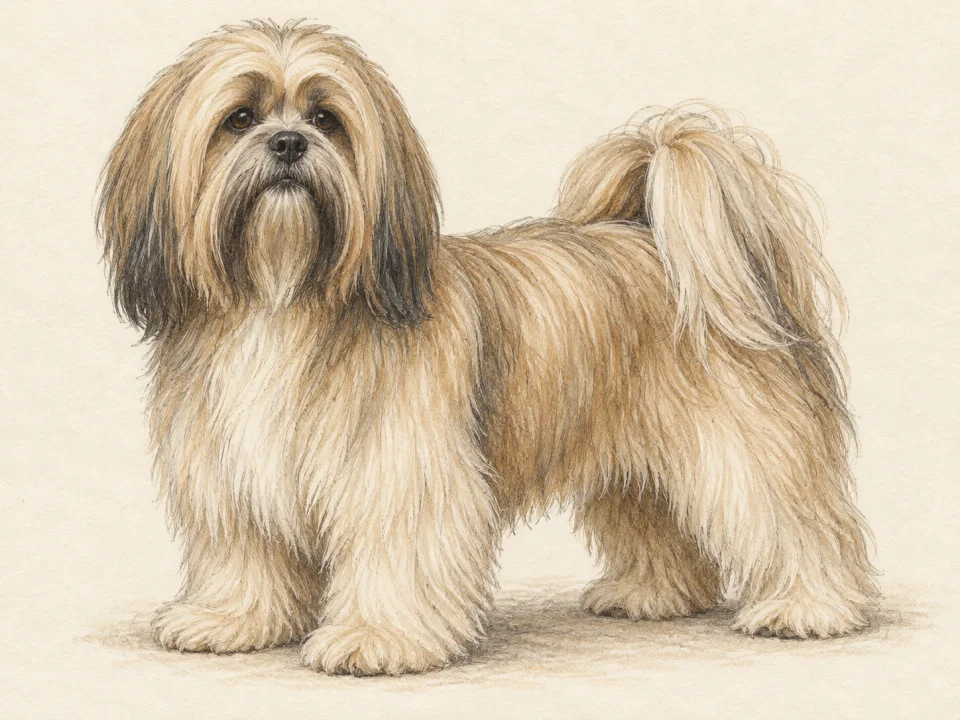
Understand the alert companion behind the hair
The Lhasa’s history includes serving as a sentinel, and the breed can be reserved around unfamiliar people while playful with family. Let visitors give the dog space instead of demanding immediate contact. Prepare a quiet place during a busy arrival. Small size does not justify ignoring hesitation or handling the dog without warning; confidence grows from predictable, manageable interactions.[1]
Choose a coat style you can actually maintain
A long coat and a shorter pet trim both require regular brushing and bathing. Discuss the ongoing routine with a groomer before selecting a style from a photograph. Check the coat near the skin, not just the surface. After washing, rinse thoroughly and dry and brush properly, because damp hair can mat even when it has just been cleaned.[1]
Treat shedding and grooming as different questions
A relatively tidy floor does not tell you whether the dog’s coat is comfortable. Loose hair and tangles still need attention within a long coat, and clipping does not eliminate routine care. Spend a few minutes checking areas that rub against equipment or furniture. If skin looks sore or brushing hurts, obtain advice rather than repeatedly forcing a comb through the same place.[1]
Make learning interesting enough to join
Lhasas can learn a wide variety of tasks but may disengage from repetitive drills. Try a brief rewarded search or one useful handling behavior, then stop at a successful point. Vary the task without changing the cue’s meaning. Avoid bullying when the dog resists; check whether the situation is confusing, uncomfortable or too difficult before asking again.[1]
Provide activity as well as a comfortable lap
The breed can enjoy brisk walks, play and mental challenges despite its modest size. Set up safe activities suited to age and condition, and leave room for quiet recovery. AKC lists males at 10–11 inches, females slightly smaller, with a 12–18 pound weight range. Measure the individual when choosing a harness rather than relying only on a breed-size label.[1]
Keep health uncertainty explicit
The AKC lifespan reference is 12–15 years. Its health discussion identifies hereditary kidney dysfunction and notes the lack of a reliable carrier test in the cited guidance. Ask about family history, eye problems and other relevant records. An empty recommended-test panel must not be interpreted as a clean bill of health or a promise that a routine check excludes inherited disease.[1]
Frequently asked questions
Does low shedding make a Lhasa Apso easy to groom?
No. Both a full coat and a shorter trim need regular maintenance. Loose hair and tangles can remain in the coat even when little hair is obvious on the floor.
Source [1]Can a puppy cut replace regular brushing?
No. A clipped Lhasa still needs brushing and care between grooming visits. Thorough drying after bathing also matters because damp hair can mat.
Source [1]Are Lhasa Apsos always friendly with strangers?
The breed can be reserved with unfamiliar people. Give the individual space and gradual, positive introductions rather than expecting immediate close contact.
Source [1]Can a routine health check rule out inherited kidney problems?
It should not be presented that way. The cited AKC guidance notes no reliable carrier test for the hereditary kidney problem it describes; request family history and veterinary advice about the individual.
Source [1]FAQ sources
- American Kennel Club — Lhasa Apso breed and care guidance ↗FAQ reference 1
Sources & methodology
Breed-level measurements and comparison scores provide context. They do not predict an individual dog's health, behaviour or suitability. Open the original publisher pages below to verify the facts and compare any later updates.
- American Kennel Club — Lhasa Apso breed and care guidance ↗Reference 1 · reviewed 2026-09-27
Make it about your dog
Build a profile around your dog's age, experiences and everyday needs.
Meet your dog →Explore local care