
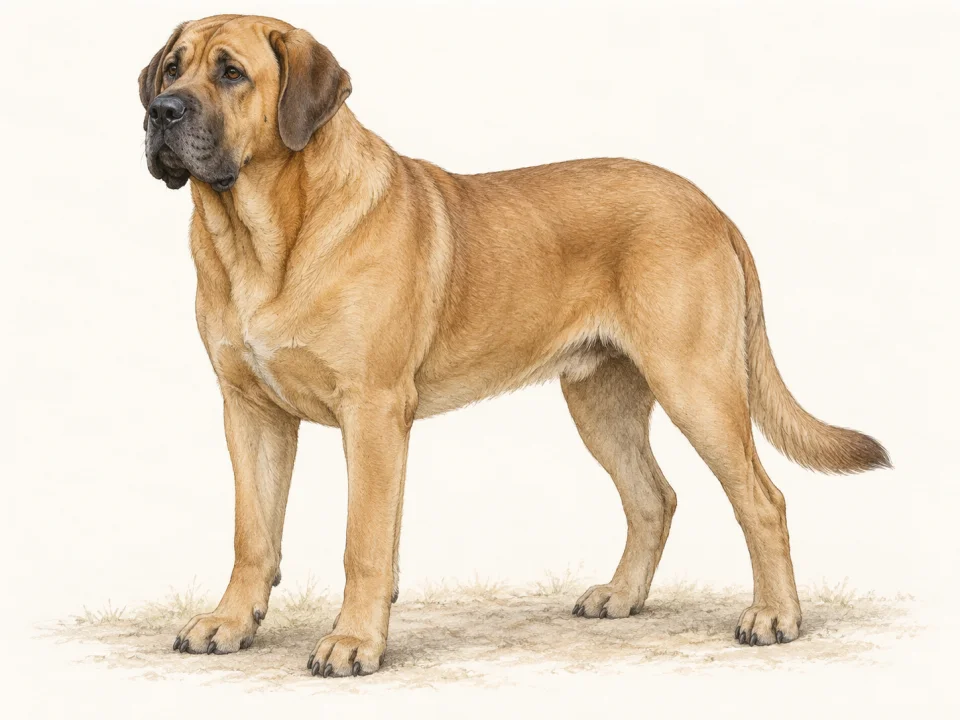
Plan for the full-sized Danish companion
AKC references 27.5–29.5 inches and 90–150 pounds. Before bringing one home, check the space available for resting, transport and moving through doors. Discuss how veterinary visits and care would work if the dog could not walk comfortably. This planning is more useful than assuming a calm temperament will make a very large dog physically easy to manage.[1]
Teach greetings before enthusiasm becomes heavy
A Broholmer may enjoy close contact, but leaning or climbing onto someone can be impractical at adult size. Reward standing calmly and settling beside people rather than insisting on contact. Supervise children and vulnerable adults even with a familiar, friendly dog. An affectionate intention does not prevent an accidental collision, and the person should always be able to end the interaction.[1]
Understand watchfulness without assigning a guarding job
AKC describes the breed’s historical work around homes, cattle and markets, including an association with Danish butcher shops. That background does not require encouraging threatening behavior today. Practice controlled visitor arrivals and provide separation when needed. Evaluate the particular dog’s response to strangers rather than relying on a historical role or a broad claim that the breed is good-natured.[1]
Choose movement suited to the individual
Walks, supervised play and simple learning games can support an engaged routine. A large dog’s apparent agility is not permission to copy a demanding adult sport plan with a puppy or an unconditioned dog. Ask for guidance appropriate to growth, health and fitness. Build outings around comfortable participation and recovery rather than how impressively the dog can jump once.[1]
Make routine care physically manageable
Weekly grooming and occasional baths are the cited baseline, alongside regular nails, ears and teeth. Practice short sessions of cooperative handling in a comfortable position. Identify a bathing space and equipment that actually fit an adult Broholmer before they are needed. Being able to inspect a foot calmly is more useful than postponing care until several people must struggle to restrain the dog.[1]
Request health records rather than a generic assurance
AKC gives a reference lifespan of 8–10 years and recommends health screening, but the cited page does not list a named test panel. Ask which assessments were performed, obtain identifiable results and discuss them with your veterinarian. Also ask about the individual’s current mobility and care history; a general description of a healthy breed is not a medical evaluation.[1]
Frequently asked questions
How large is an adult Broholmer?
AKC references 27.5–29.5 inches and 90–150 pounds. Plan transport, equipment and handling around the actual dog, not just its puppy size.
Source [1]Does a calm Broholmer still need supervised greetings with children?
Yes. Size and affectionate contact can cause accidental collisions. Teach calm approaches and ensure children can move away with adult supervision.
Source [1]Should I encourage guarding because of the breed’s history?
A historical guarding role is not a reason to encourage threats. Focus on controlled introductions, clear household routines and appropriate management of the individual.
Source [1]Does the cited AKC page name a required screening panel?
It recommends screening but provides no named panel. Ask for the actual examinations and reports and review their meaning with a veterinarian.
Source [1]FAQ sources
- American Kennel Club — Broholmer breed and care guidance ↗FAQ reference 1
Sources & methodology
Breed-level measurements and comparison scores provide context. They do not predict an individual dog's health, behaviour or suitability. Open the original publisher pages below to verify the facts and compare any later updates.
- American Kennel Club — Broholmer breed and care guidance ↗Reference 1 · reviewed 2026-09-27
Make it about your dog
Build a profile around your dog's age, experiences and everyday needs.
Meet your dog →Explore local care